What the Cut? Let’s Talk Trencher Attachments for Skid Steers and Compact Track Loaders
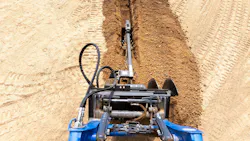
You could write a million stories about skid steers and compact track loaders. In fact, it feels like I’ve written a million already. It’s a testament to these loaders’ versatility. Fit a skid steer or CTL with a new attachment, and suddenly you have a new story to tell. Today, let’s add a chapter on trenchers. These attachments cut narrow, clean trenches for utilities, irrigation, drainage, and cable installs. They work tight to structures. They minimize disturbance. And they let fleets trench with machines they already own. But be warned: This is not a simple attachment category. Performance hinges on hydraulics, chain setup, soil type, and operator technique. So today, let’s talk trenchers.
A quick overview of the trencher attachment market
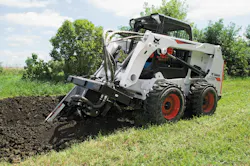
The trencher market today offers a mix of products from the attachment manufacturers (Blue Diamond, Digga, Auger Torque, Premier, and beyond) to the host machine makers (Bobcat, Cat, Case, New Holland, ASV, Yanmar, Manitou, and beyond). Dig depths can go from 36 inches to 48 inches to 60 inches, depending on the model. Cutting widths range from 4-, 6-, 8-, 10-, and 12-inch options. A 4-ft boom with a 6-inch-wide chain is popular. Most trenchers target common install depths between 3 and 5 feet. This is trenching for water lines, electric cables, fiber-optic installs, and even creating footings. Pricing is approachable compared to dedicated trenching machines. Expect roughly $4,000 to $10,000 purchase price. Expect even higher prices for high-flow units with severe-duty builds.
Hydraulics make or break a trencher
Most compact loaders fall into two buckets:
- Standard flow: roughly 8 to 30 gpm, 3,000 to 3,500 psi
- High flow: roughly 30 to 50 gpm, 4,000 to 5,000 psi
Standard flow handles most utility and landscape trenching. High flow adds more torque, more chain pull, and better performance in tough ground. Some systems can nearly double digging force. Note: Throughout this article we'll use "gpm" for gallons per minute of hydraulic flow and "psi" for pounds per square inch of hydraulic pressure.
Technology trends: smarter, tougher, more flexible
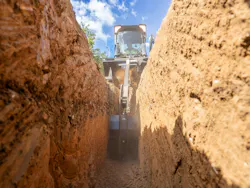
This category is still evolving, even if it is an old-school implement. Modern trenchers focus on durability and control. Hydraulic motors and gearboxes are getting more efficient. Expect reinforced frames, better wear protection, and easy-to-service components. Chain options are expanding fast, with combinations for soft soil, mixed ground, and rock. Key features showing up more often:
- Side shift for trenching tight to obstacles
- Reverse rotation, which momentarily reverses the chain direction to minimize stalling
- Adjustable spoil augers for cleaner trenches
- Crumber bars for better trench bottoms
- Depth control systems for consistent cuts
- Planetary drives for better torque and durability
Trencher buying and operational tips
EDITOR’s NOTE: These next four sections were written by Matt Walsh, product consultant with Caterpillar. We thank him.
Match the attachment to your loader’s hydraulics:
Before you buy or rent, confirm the machine's auxiliary hydraulic flow and pressure. Standard-flow hydraulics handle many utility and landscape trenches, but high-flow hydraulics can deliver substantially more torque and chain pull for severe digging and steeper trenching angles. The goal is a balanced match — enough hydraulic power to keep chain speed and torque up without constantly stalling.
Pick chain type and width for the soil type and application:
Cup-style teeth typically suit soft-to-normal soils; full-carbide styles are better for rocky, compacted, or abrasive conditions; and combination chains can be a good one-chain-for-many-jobs choice — especially for rental fleets. Use the narrowest trench width your installation requires to maximize productivity. A narrower cut can be noticeably faster than a wider one. In low-resistance or wet soils, tooth spacing on the chain at every other link station can help shed material quicker; in hard or compacted ground, teeth at every station can improve material breakup and conveyance.
Optimize trenching operations:
Most machine-mounted trenchers are designed to cut with the loader traveling in reverse at a slow, steady pace with continuous auxiliary flow. For general work, keep the boom roughly 45 to 65 degrees below horizontal; going steeper trenching angles can reduce cutting efficiency and spoil removal. Use features like side shift to trench close to structures, and adjust the spoil auger to place material where you want it. Crumber bars can clean the bottom of the trench and reduce power loss from re-churning spoil — but in wet, sticky soil they may clog and hurt reduce productivity.
Mind your maintenance points:
Correct chain tension is critical: follow the manufacturer’s manual, but a common rule of thumb is about 1.5 to 2 inches of chain sag away from the underside of the boom. Too tight robs horsepower and accelerates wear; too loose can lead to derailing. Inspect teeth often and replace dull, worn or broken cutters — dull teeth reduce digging efficiency, increase shock loads and can contribute to chain stretch. Grease serviceable points as specified (some front idlers are recommended every 10 hours, with other grease points daily). When in doubt, default to the operation and maintenance manual.
Now, check out some trencher attachments
We pulled together a range of trencher attachments from across the industry. Different sizes. Different flow requirements. Different duty classes. Some models target light utility work. Others are built for rock, frost, and long production days. Scan the specs. Match them to your machines. There’s always more info on these units via those website links.
Blue Diamond’s heavy-to-severe duty trencher lineup
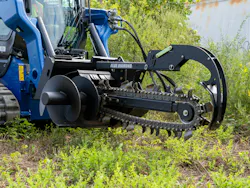
Blue Diamond Attachments offers a comprehensive lineup of trenchers attachments designed to match specific applications and machine requirements. With Heavy, Extreme, and Severe Duty models, operators can select the ideal combination of cutting depth and width — ranging from 36- to 60-inch depths and 4- to 12-in. widths — to meet precise jobsite demands. This flexibility ensures optimal trenching capacity across a wide range of projects. Built for durability, Blue Diamond trenchers feature reinforced high-stress areas, continuous welds, and added gusseting to prevent deformation in tough conditions. Practical design elements — including manual side-shift capability, extended auger flighting, multiple chain options and a self-adjusting crumber — enhance usability and performance.
Compatible with both skid steers and track loaders, these trenchers accommodate hydraulic flows from 13 to 45 gpm, ensuring versatility across nearly all OEM machines. The result is a high-performance solution that increases productivity, reduces rework, and delivers consistent, professional trenching results. All trenchers come with the Blue Diamond Satisfaction Guarantee and are backed by a 1-year warranty. For more info, visit Blue Diamond’s website.
Cat trenchers scale from standard to high-flow power
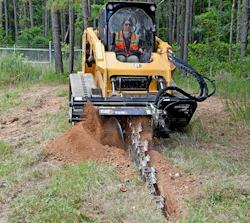
Caterpillar’s skid steer and compact track loader trencher lineup includes three base models —T109 (36-inch boom), T112 (48-inch) and T315 (60-inch) — built to cut narrow, straight trenches for utilities, irrigation, drainage, and water and gas lines across residential, commercial, agricultural and grounds-maintenance jobsites. A square-tube frame helps resist bending and twisting without sacrificing visibility, while welded high-strength wear plates and a fully serviceable, greaseable front idler support long-term durability. Chain tension is adjusted with a grease ram for fast, easy service. The T109 and T112 run on standard-flow hydraulics (11 to 23 gpm at 2,100 to 3,400 psi), while the T315 pairs with High Flow XPS (25 to 40 gpm at 3,300 to 4,500 psi) for roughly double the torque and chain pull in severe digging. Chain widths of 6, 8, 10 and 12 in. are available with Standard Cup, Terminator, Carbide/Cup Combination and Rock-Frost options, plus features like side shift, an adjustable spoil auger, and optional crumber bars. For more info, visit Cat’s website.
Bobcat builds trenchers for every jobsite
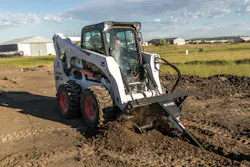
The Bobcat trencher lineup delivers powerful, precise trenching performance for skid steer loaders tackling demanding jobsite conditions. Spanning nine trencher attachment sizes, the lineup allows operators to select models properly matched to their machine and application — from light-duty landscaping to utility and irrigation installation. Built for durability and consistent performance, Bobcat trenchers are engineered to cut through a wide range of ground conditions, including hard packed and rocky soil conditions. Multiple chain and tooth configurations allow operators to optimize cutting performance and maximize productivity in varying ground conditions. A side-shift feature — manual or hydraulic depending on the model — enables trenching close to buildings, fences and other obstacles, improving accuracy and efficiency in tight spaces.
Select models, including the LT313, LT405 and LT414, offer trench depths from 3 to 5 feet to meet common utility installation requirements. High-flow hydraulic compatibility on select units delivers added digging power, while features like dual augers help move spoil away from the trench for cleaner, more efficient operation. Ideal for contractors, municipalities and rental fleets, Bobcat trenchers provide a versatile, job-ready solution for installing water lines, power cables and drainage systems with confidence. For more info, visit Bobcat’s website.
John Deere's TC36 tackles light-duty trenching with precision
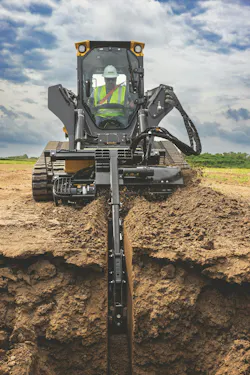
The John Deere TC36 trencher attachment is designed for light-duty trenching tasks in agriculture and small construction projects. It mounts to skid steer loaders or compact track loaders, making it a versatile tool for digging narrow trenches for utilities such as water lines, electrical cables, or drainage systems. The TC36 features a low-profile chain and sprocket drive powered by a standard-flow hydraulic motor, which provides smooth and efficient operation in typical soil conditions. With a maximum trench depth of 36 inches and a weight of about 1,130 pounds, it balances performance with maneuverability. The attachment includes a manual side-shift function that allows operators to trench close to buildings or obstacles. A spring-loaded boom helps absorb shock, reducing wear on both the machine and operator. For more info, visit John Deere's website.
Takeuchi trenchers offer 36- to 60-inch depths and high-flow performance
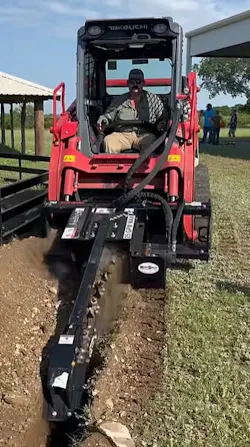
Takeuchi trencher attachments for compact track loaders are engineered for efficient, consistent trenching across a variety of jobsite conditions. Available in configurations offering digging depths of 36, 48, or 60 inches, the trenchers are designed to match application requirements ranging from irrigation and utility installation to general construction. A direct drive motor helps maximize power transfer and durability, while a manual side-shift function allows operators to trench close to structures, fences, and other obstacles. Standard features include a crumber system that keeps trench bottoms clean and smooth, and an adjustable auger that folds down for transport and storage without tools. Reverse chain rotation helps clear obstructions, and chain tension can be adjusted quickly to maintain performance in varying soil conditions. The trencher drive unit supports standard flow up to 25 gpm and high-flow operation up to 42 gpm, making it compatible with a wide range of compact track loaders. For more info, visit Takeuchi's website.