Wheeled Excavators Explained: Benefits, Buying Tips, and New Machines
Key Highlights
- Wheels mean these machines motor. Wheeled excavators are great at roading and projects on paved surfaces. Speeds go up to 20-plus mph.
- Think road warrior tool carrier. Buckets, breakers, grapples, mowers, and tiltrotators create a serious do-everything unit. George Miller would love these machines.
- There's a lot of choices. Cat, Volvo, Develon, Mecalac, Liebherr, Hyundai, Hitachi, and lots more all have wheeled iron worth a look.
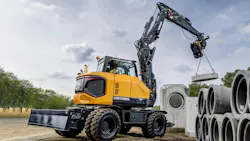
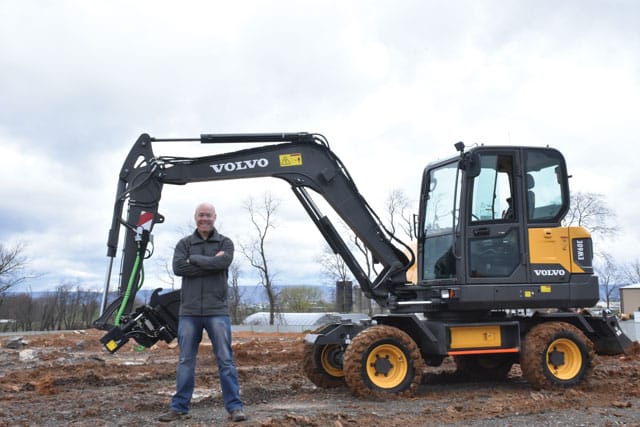
You always remember your first, right? The first time I operated a wheeled excavator was in 2018, and I remember thinking that wheels added a pretty interesting dimension to the dig category of equipment. Volvo Construction Equipment had invited me to its Customer Center in Shippensburg, Pennsylvania, to operate the EW60E. I was apparently the first North American journalist to get behind the controls. Look at this guy!
Operation was (is) definitely different. There's a steering wheel in front of you. I could also steer with the joysticks. On the Volvo unit, there was an oscillating axle I could lock for stability. Then I could drop the dozer blade and dig like a traditional excavator, but digging was different too. When I dug aggressively through that Pennsylvania sludge, the bucket would pull the machine forward. Tracks do offer better traction, but tracks are also slow and hard on pavement. Wheeled excavators can navigate jobsites with finished surfaces at 20+ mph and leave little sign they were ever there.
Stability is different. A wheeled excavator sitting freely on its tires generally has less inherent stability than a comparable crawler because tracks provide a larger, more stable footprint. But wheeled excavators are specifically designed to compensate with axle locks, dozer blades, and outriggers. You can choose between two or four stabilizers.
Units might also come with four wheels or eight wheels, which affects stability and lifting as well. A four-wheel/single-tire setup generally makes the excavator narrower and more maneuverable. Dual tires — eight tires total — give the machine a wider footprint but promote better flotation, traction, and stability.
The basic tradeoff between the two undercarriages: Tracks excel at crawling around the ground, and tires excel on paved surfaces and at travel projects. Eight years later, those are still the two most important tips.
But why put an excavator on wheels?
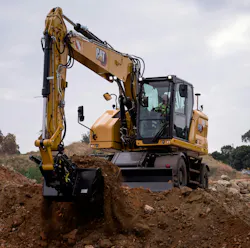
Solid question. A wheeled excavator takes the familiar 360-degree upper structure of a crawler excavator and puts it on a road-warrior undercarriage. That changes your logistics. Instead of creeping around a project at crawler speeds, you can mosey at 24 mph. There are roading packages with lights, mirrors, cameras, license-plate brackets, fenders, beacons, and cool roading modes for operation. So, no trailer needed. That type of mobility makes these machines popular with road and bridge crews, utility companies, and do-everything municipal teams. It’s the same reason backhoes are also popular with those crowds.
Wheeled excavators are also nimble on pavement using cool steering options like four-wheel and crab steer.
Then there’s the attachment factor. A wheeled excavator can wield buckets, breakers, grapples, mowers, compactors, and tiltrotators. I recently interviewed Tim Cicora, product manager for medium and large excavators at Hitachi/Landcros. He made a point of singling out tiltrotators.
“We think [wheeled excavators] will be a great application for a tiltrotator,” said Cicora at the company’s recent dealer meeting (where they announced two new wheeled excavators that you can read about below). “It allows an operator to get as much productivity and maneuverability out of the front of the machine, and it allows an operator to pick up multiple attachments, buckets, whatever they need to use, a mower, and set them back down and pick up the next one as quickly as possible.”
“Wheeled excavators” doesn’t quite describe these machines. These are increasingly mobile tool carriers, and there are a lot more of them to choose from than when I climbed into that EW60E way back in 2018. Before we get into that, let's learn about...
Why more contractors are trading tracks for tires
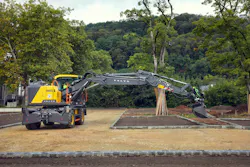
This section was written by Lars Arnold, product manager of wheeled excavators, at Volvo Construction Equipment.
Ditching tracks for rubber tires is transforming how many contractors map out their logistics. If you’re weighing the shift, consider these five operational realities:
Zero performance deficit: A common myth is that wheels sacrifice stability. When deploying outriggers or dozer blades, a wheeled model typically matches the exact breakout force, digging depth, and lifting capacity of a tracked counterpart.
One machine for multiple jobs: These machines aren’t just for highway shoulders. Swapping out standard attachments allows them to shift seamlessly from deep utility digging to scrap handling or urban demolition.
Significant labor savings: Road-legal travel speeds of up to 23 mph mean you can drive these machines straight to local jobsites, completely eliminating the labor, lowboy transport logistics, and CDL requirements of moving a crawler.
Minimal site restoration: Rubber tires prevent the extensive turf gouging and asphalt scarring caused by steel tracks. You’ll drastically cut down on post-job ground repair and surface cleaning costs.
Fewer operational resets: Equipping the machine with an advanced tiltrotator lets operators rotate attachments 360 degrees and tilt side to side, allowing them to dig, lift, and backfill from one stationary position without constantly shifting the undercarriage.
Moving equipment between local jobsites shouldn’t be a logistical headache. Ask yourself: How much faster could your projects move if your primary excavator didn’t require a trailer to travel to the next job?
5 wheeled excavator buying tips
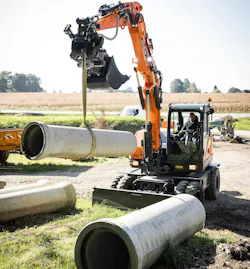
This section was written by Brian Kim, product manager for heavy excavators at Develon.
- Align specs to applications: Evaluate primary tasks such as roadway maintenance, utility placement, or urban site development before selecting a machine size. Match the machine’s hydraulic capacity to intended attachments, such as tiltrotators, breakers, or thumbs, and consider models with programmable auxiliary flow presets to streamline attachment usage.
- Match undercarriage configurations to lifting requirements: Stability directly impacts lifting capacity since wheeled models use stabilizers instead of wide tracks. Review excavator lift charts carefully to determine whether a front dozer blade with rear outriggers or a four-outrigger setup best fits your jobsite conditions. Adding an articulated boom can further optimize positioning and heavy lifting geometry (available for select models).
- Prioritize visibility and proximity detection systems: Because wheeled excavators frequently operate near live traffic and ground crews, visual awareness is vital. Look for models equipped with 360-degree around view monitoring (AVM) camera systems, ultrasonic proximity sensors, and high-output LED lighting to protect jobsite personnel and reduce damage risks in tight quarters.
- Factor TCO savings into the purchase decision: While purchase prices differ from tracked models, wheeled excavators deliver long-term operational savings. High road speeds eliminate the need for dedicated transport trucks, trailers, and drivers between local jobsites. Furthermore, tire replacement and ongoing undercarriage upkeep cost significantly less than track maintenance.
- Consider premium cab ergonomics: Working in confined areas requires agile steering setups, such as four-wheel, crab-steer, and boom-swing functions, combined with compact tail swing designs. To sustain productivity through long shifts, ensure the machine includes operator-focused upgrades like load isolation (ride control), heated and cooled suspension seating, and joystick steering.
These wheeled excavators bring mobility to the jobsite
Alrighty, here’s what you’ve been waiting for the — the machines. Here’s a look at some of the latest wheeled excavators available to contractors and fleets in North America. Go ask your local dealers for some test spins.
Cat M319
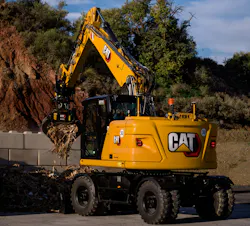
The Cat M319 wheel excavator is designed to help contractors maximize productivity in urban, roadside, and other space-constrained applications. Featuring a compact front and tail swing radius, the machine helps deliver the maneuverability needed to work efficiently in tight jobsite environments while maintaining strong digging and lifting performance. Powered by a Cat C4.4 engine, the M319 offers travel speeds up to 21.7 mph for quick movement between jobsites. Optional Cat technologies, including Cat Grade with Assist, Cat Payload, and Cat Grade 3D Ready, help operators improve accuracy, hit load targets, and reduce rework. The excavator also integrates with Cat tiltrotator systems for added versatility. Operator-focused features include deluxe and premium cab options, a 10-inch touchscreen monitor, and customizable Operator ID settings, while extended maintenance intervals and ground-level service access help reduce downtime and lower owning and operating costs. For more info, visit Caterpillar’s website.
Volvo CE’s EWR130, EWR150, and EWR170
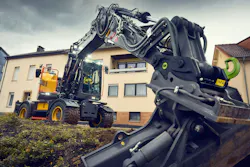
Working on tight urban jobsites or crowded roadside shoulders usually means fighting for every inch of clearance. Volvo tackles this headache head-on with its EWR130, EWR150, and EWR170 wheeled excavators. While these models keep their ultra-short tail swing, the big news is up front: Volvo shaved nearly 2 feet off the front swing radius, meaning operators can swing and dump more safely within a single traffic lane. The smaller EWR150 also gets a huge boost, bumping up to 154 horsepower to match the muscle of the larger EWR170 for faster cycle times and effortless digging. One of the most popular upgrades is an industry-first safety feature: electronically retractable access ladders. They make climbing into the cab much easier, and they automatically lock out the machine’s travel when extended, so you never accidentally drive off while they’re down. And the EWR130 features the shortest rear (5 feet, 1 inch) and front (5 feet, 11 inches) swing radius on the market, providing enhanced safety and comfort when working in confined spaces. For more info, visit Volvo Construction Equipment’s website.
Develon DX100W-7, DX140W-7, DX190W-7, and DX210W-7
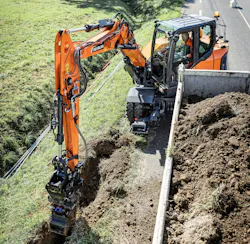
The Develon wheeled excavator lineup includes three heavy-duty machines and a compact (mini) model built for urban, utility, and road construction.
Compact excavation — DX100W-7: The first Develon mini wheel excavator features a 100-horsepower engine, 25,000-pound operating class and travel speeds up to 24 mph. Built for tight spaces, it offers three steering modes (two-wheel, four-wheel crab, and four-wheel round), an articulated boom, and a standard 270-degree around view monitoring (AVM) camera system.
Heavy-duty performance — DX140W-7, DX190W-7, and DX210W-7: Ranging from 137 to 171 horsepower, these heavy models deliver enhanced digging force, fuel-saving Smart Power Control, and configurable undercarriages with outriggers or dozer blades. They feature quiet, ergonomic cabs and an optional 360-degree AVM camera system.
For more info, visit Develon’s website.
Mecalac 7MWR, 9MWR, and 11MWR
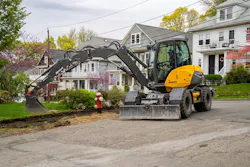
Mecalac offers its award-winning MWR Series of wheeled excavators. Consisting of three models — the 7MWR, 9MWR, and 11MWR — the series features a range of benefits to help meet the needs of operations in the construction, landscaping, and forestry industries, as well as municipalities and utility construction. The MWR Series is purpose-built to allow for maximum maneuverability in tight working areas, offering the flexibility and versatility of a skid steer or compact track loader in one machine and delivering higher speed and mobility than tracked excavators. Each of the three models in the MWR series offers speed in a compact footprint. The smallest of the three, the 7MWR, offers variable speed between 0 and 19 mph, while the larger 9MWR and 11MWR provide standard travel speeds between 0 and 12 mph with an option for enhanced speed up to 22 mph on the 9MWR and 19 mph on the 11MWR. The MWR series machines have a center of gravity that is 20 percent lower than competitive models while still maintaining a high ground clearance. For more info, visit Mecalac’s website.
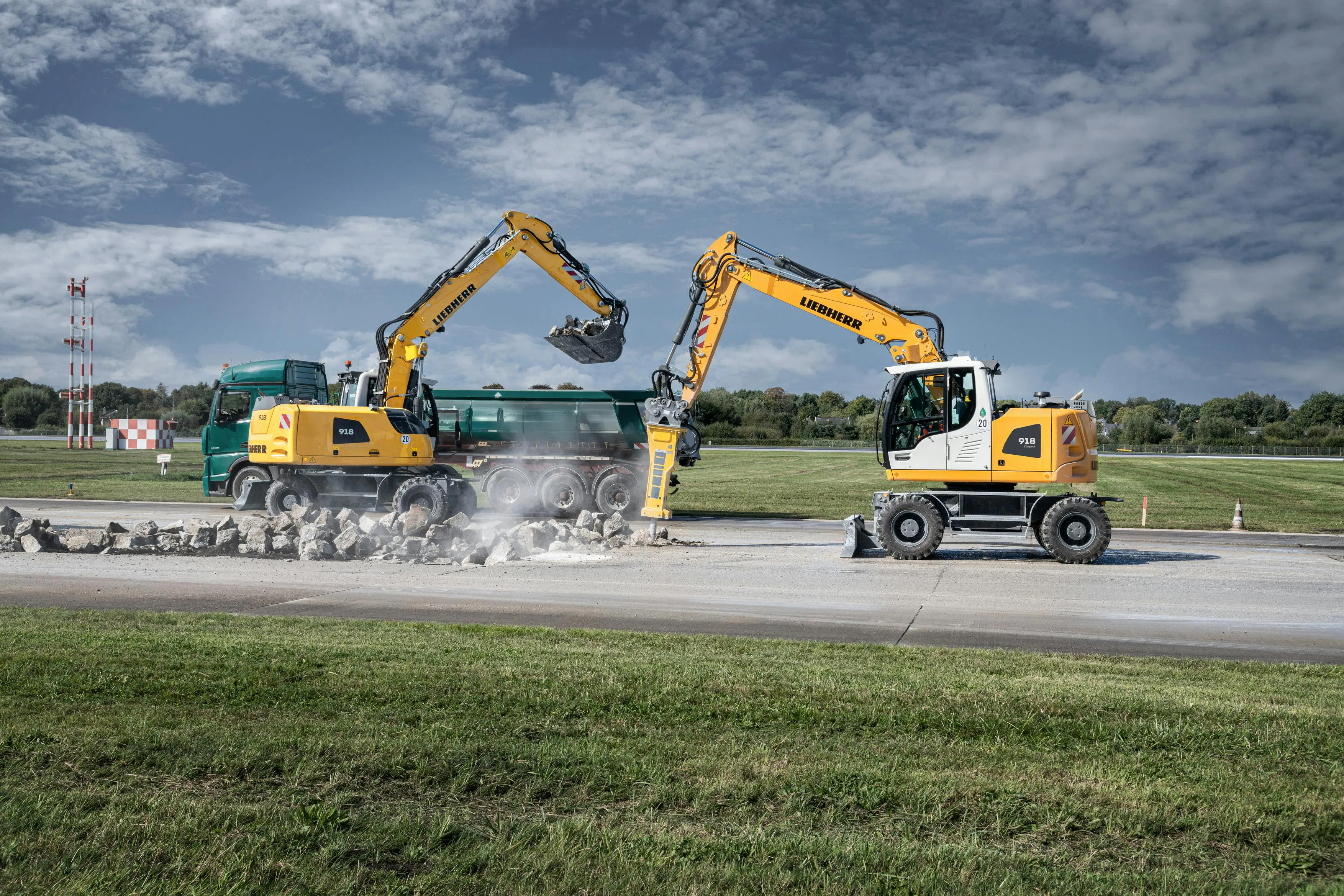
Liebherr wheeled excavators
While wheeled excavators have traditionally been viewed as a niche product, they are rapidly gaining popularity among municipalities, townships, cities, utility contractors, and road maintenance crews as true multi-tool carriers. Today's wheeled excavators are expected to utilize a wide range of attachments, including tiltrotators, grapples, compactors, mowers, hammers, and other specialty tools. To maximize attachment performance, Liebherr wheeled excavators can be factory-equipped with high-flow auxiliary hydraulics, with the option for a second high-flow auxiliary circuits for demanding applications. Operator comfort is equally important, which is why features such as ride control, automatic digging brakes, and joystick steering are available. Liebherr's automatic ride control system engages when travel speeds exceed 2 mph, reducing vibration and providing a smoother ride between jobsites. Safety is enhanced through advanced 360-degree camera systems and working envelope limitation technology, which helps prevent accidental contact with obstacles by automatically slowing and stopping machine movements before preset limits are reached. Together, these features transform the wheeled excavator into one of the most versatile machines on any fleet. For more info, visit Liebherr’s website.
Hyundai HW100A and HW210A
HD Construction Equipment Hyundai North America offers an extensive wheeled excavator product line, with five HW series models and one R series compact model to fulfill a wide range of on-road and off-road applications. Hyundai’s Tier 4-Final-compliant wheeled excavators are fuel efficient, while delivering fast travel speeds and productivity, with enhanced cabs and added safety features. The Hyundai HW series wheeled excavator models range in size and power from the 11-ton HW100A model, rated at 100 net horsepower to the 21-ton HW210A model, providing 170 net horsepower. Variable-power control with three power modes provides the highest performance in any operating environment. P (power mode) maximizes speed and power for heavy work. S (standard mode) optimizes performance and fuel efficiency for general work. E (economy mode) improves control and efficiency for lighter work. Like all Hyundai equipment, Hyundai wheeled excavators come with Hyundai’s industry-leading warranty and five years of free access to Hyundai Connect, the company proprietary telematics system for remote monitoring and support. For more info, visit HD Construction Equipment’s website.
Hitachi/Landcros ZX180W-7 and ZX220W-7
This summer, Hitachi Construction Machinery Americas, soon to be rebranded to Landcros Americas in April 2027, is expanding its lineup and range of solutions for customers with the new ZX180W-7 and ZX220W-7 wheeled excavators. Whether working on infrastructure, utility, or road projects, customers are looking for ways to do more with less. The ZX180W-7 and ZX220W-7 deliver the performance and fuel efficiency to help them do just that. Key features include:
- Customizable settings let operators adjust swing speed, arm responsiveness, and attachment performance to suit the job.
- An enhanced hydraulic system reduces fuel consumption while maintaining performance.
- Automatic Transmission Control selects the optimal gear based on travel load.
- A newly designed cab helps reduce operator fatigue during long workdays.
- Advanced features such as Auto Working Brake (AWB), Cruise Control, and Public Road Mode further enhance ease of operation.
The ZX180W-7 and ZX220W-7 are more than just new machines. Built on Hitachi Construction Machinery’s Japanese manufacturing heritage and customer-first philosophy, they are trusted partners that help customers achieve more on the modern jobsite. For more info, visit Hitachi Construction Machinery Americas’ website.
Case WX210E
Case Construction Equipment’s WX210E wheeled excavator packs 24 tons of mobile, high-tech muscle into a short-radius machine built to move quickly between demanding jobs. Its fuel-efficient 170-horsepower engine delivers serious breakout, lifting, and craning capability, while a load-sensing hydraulic system with advanced flow sharing provides smooth, precise response for lifting and handling work. Five working modes — including a dedicated lifting mode and one customizable mode — help operators match performance to the task. A three-speed hydrostatic transmission, permanent 4WD, and front axle oscillation lock deliver confident traction and stability, with road speeds up to 25 mph. Inside the spacious cab, an 8-inch touchscreen with jog dial puts machine functions at the operator’s fingertips, while joystick steering, a heated high-back seat, Auto Climate Control, adjustable speed cruise control, and ride control support all-day comfort. Standard all-around LED lighting improves visibility day or night. Together, these features make the WX210E a versatile, road-ready solution for urban construction, infrastructure, utility, and municipal work where mobility, power, and precision matter most. For more info, visit Case Construction Equipment’s website.
About the Author
Keith Gribbins
Keith Gribbins is the head of content at Construction Equipment, where he leads editorial strategy across print, digital, video, and social channels. An award-winning journalist with more than 20 years of experience, Keith has won 17 national and regional editorial awards and is known for his hands-on reporting style, regularly visiting manufacturers, operating equipment, and covering major industry events worldwide.