Mid-Sized Wheel Loader Guide: Applications, Technology, and Models Compared
Key takeaways:
- Mid-sized wheel loaders offer a wide range (75 to over 200 hp) and are built for production. Fast travel speeds, strong breakout force, and big reach keep trucks loaded and jobs moving.
- One machine, many jobs — with buckets, forks, grapples, and more, these loaders handle everything from truck loading to snow removal.
- Smarter machines are driving decisions — telematics, payload weighing, and fuel-saving systems now play a major role in total cost of ownership.
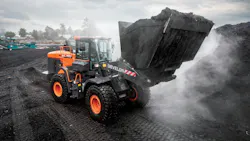
Wheel loaders are made to move some material. Dirt, gravel, snow, sand, asphalt millings, riprap — just wave in a wheel loader with the right bucket or attachment and handle serious bulk material transport. Lately, I’ve been crushing on the mid-sized segment. It’s a class that has a very large variety of specs and sizes. In this article, I highlight everything from Bobcat’s 74-horsepower L95 to Caterpillar’s 225-horsepower 950. That’s a huge spread — and that’s exactly why this segment is so interesting.
So today, let’s take a look at this mid-sized wheel loader market. These loaders offer big buckets, great visibility, fast travel speeds, high reach, cool tech, attachment options, and good maneuverability. I gathered OEM insights from JCB, Komatsu, and New Holland, which I'll mix into my outlook and some product profiles of the industry's standout machines. Overall, this guide breaks down why wheel loaders in general deserve a closer look.
What these machines actually do all day
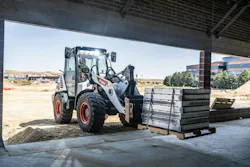
Mid-sized loaders are material movers first, but these units also use attachments (pallet forks, snowblowers, box plows, grapples, brooms, cold planers, and beyond). You’ll see them loading trucks, feeding crushers, handling pallets, and moving snow in winter.
Common mid-sized wheel loader applications:
- Load-and-carry work (bucket and pallet)
- Stockpile management
- Truck loading
- Waste and recycling operations
- Ag and landscape yards
- Snow removal and municipal work
They’re also mobile. Fast travel speeds let operators cover ground without a trailer — usually around 20 to 25 mph. That alone can change how a jobsite flows. How are mid-sized wheel loaders used? Like bucket fill, truck placement, and cycle time. That sort of stuff. If you want a quick refresher, go read Larry Stewart’s “How to Use a Wheel Loader.” It’s a classic evergreen CE feature.
Tech and options for mid-sized wheel loaders
This is where mid-sized wheel loaders separate themselves. Smarter systems are showing up across this class. Those include:
- Hydrostatic or power-shift transmissions for smoother control
- Quick couplers for easy attachment exchanges
- Ride control systems to keep material in the bucket
- Parallel lift for keeping the attachment (bucket or pallet) level to the ground through the entire lift range
- Return-to-dig and kickout features for repeatable cycles
- Traction control with automatic differential lock
- Telematics platforms tracking health, fuel, and utilization
- Payload systems that weigh material on the fly
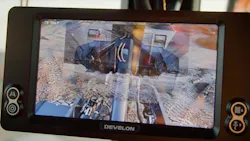
- Cameras and object detection tech for visibility and safety
- Electrification, but it's still early for this size class
- Better cabs with lots of operator comfort (heated and ventilated seats, Bluetooth radios, touchscreen displays, keyless start, etc.).
How much do these machines cost?
Let’s talk money. Because of the large variety of sizes, mid-sized wheel loaders can land somewhere between $100,000 to $300,000+ depending on size, specs, and tech. Rental is a part of this market, too.
Five critical factors when choosing a mid-sized wheel loader
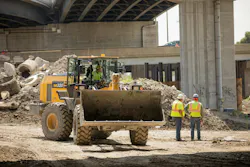
This section was written by Reuben Talukdar, product marketing manager with Komatsu.
Choosing the right mid-sized wheel loader requires balancing performance, efficiency, and operator usability to match the demands of diverse jobsites. Here are five things you should consider when making this important equipment decision.
- Application versatility: A strong mid-sized loader should perform multiple tasks without compromise, from loading and material handling to cleanup and attachment work. The objective is to provide a single machine that delivers consistent performance across a wide range of applications.
- Maneuverability: Jobsites are often tight and constantly changing. The right loader should be easy to position, with a tight turning radius and the ability to move efficiently around trucks, buildings, and confined areas.
- Smooth control: Look for a machine that delivers smooth, predictable operation especially at low speeds. A hydrostatic transmission is an excellent choice, as it provides seamless, linear power with no shifting and superior inching control. This improves precision, reduces rework and minimizes operator fatigue.
- Attachment flexibility: In general construction applications, the machine must perform just as effectively with attachments such as forks, brooms, and grapples, as it does with a bucket. Strong, responsive hydraulics, intuitive control, and parallel lift capability are essential for precise material handling and keeping loads level throughout the lift cycle. Key indicators of attachment performance include hydraulic responsiveness, stability when handling pallets of materials, and the ability to place loads accurately and consistently.
- Operating cost: Focus on total cost of operation, not just fuel consumption. Look for electronic load-sensing controls that match power to demand, traction control systems that minimize wheel slip and extend tire life, and easy service access with longer service intervals to help reduce downtime. Good traction and control reduce wheel slip, extending tire life and improving overall efficiency, while easy service access and longer service intervals help minimize downtime.
If you carefully consider these critical factors, you’ll make a wise purchasing decision that can help ensure your changing jobsite needs are met with a mid-sized wheel loader that delivers high value to your operation for many years to come.
Tips for wheel loader operation
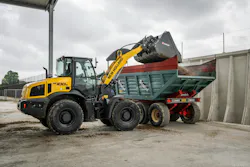
This section was written by Dan Kakareka, product marketing manager for New Holland Construction.
Operating a mid-sized wheel loader efficiently is as much about the machine’s design as it is operator technique. Today’s leading models are built to make operation more intuitive, allowing operators to focus on smooth, controlled movements throughout each work cycle. A key advantage comes from refined control systems. Machines equipped with seat-mounted joysticks and electro-hydraulic controls provide a more natural, responsive feel, making it easier to manage lifting, tilting, and travel functions with precision. Paired with a smooth hydrostatic transmission, operators can maintain consistent speeds and make quick directional changes without sacrificing control, especially valuable during repetitive loading tasks.
Visibility and awareness also play a major role in efficient operation. A modern cab with expansive sightlines, complemented by features like a rearview camera, helps operators stay aware of their surroundings and work confidently in tighter spaces. This improved visibility supports safer maneuvering and more accurate truck loading or material placement.
Fundamentals still matter. Keeping the bucket low while traveling improves machine stability, while proper rollback and leveling techniques reduce material loss and increase cycle efficiency. Responsive hydraulics make it easier to maintain the correct bucket angle when entering a pile, resulting in better fill and fewer passes.
Finally, operational efficiency extends beyond the cab. Machines designed with easy-access service points and simplified daily checks help ensure consistent performance. When operators combine solid technique with equipment built for comfort, visibility, and precise control, they can achieve higher productivity, reduced fatigue, and more consistent results across a wide range of applications.
Right-sizing a wheel loader for your operation
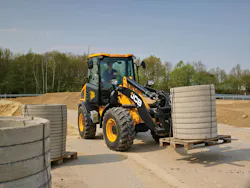
This section was written by James McMillan, product manager of wheel loaders, large excavators, and wheeled excavators at JCB.
When it comes to wheel loaders, bigger is not always better. The right machine size is the one that matches the demands of the work being done each day. Start with the material and the cycle. Material density, pile conditions, and travel distance between the pile and the truck all influence the ideal machine size. Short repetitive cycles often favor quick hydraulics and strong visibility. Longer carry distances shift the focus toward stability, ride control, and travel speed to maintain productivity and reduce spillage.
Bucket capacity and truck pairing are also key considerations. An efficient loader should fill trucks in a reasonable number of passes without constantly operating at its limit. If operators must push the machine hard just to keep up with production targets, the loader may be undersized. On the other hand, if the machine rarely feels loaded and spends much of the day underutilized, the operation may be carrying more machine than the job requires. Jobsite constraints also play a role. Tight access, overhead clearance, and ground conditions can all influence whether a more compact machine footprint makes sense. Finally, long-term operating costs should be part of the equation. Fuel consumption, tire wear, and maintenance access all affect total cost of ownership. Selecting the right-sized loader helps balance productivity with operating efficiency over the life of the machine.
Mid-sized wheel loader showcase
The following models show where the mid-sized wheel loader market is heading. Think smarter tech, better visibility, stronger breakout force, and more attachment flexibility. Each machine brings a different angle. Some lean into tech. Others focus on simplicity and size. All aim to move more material, faster.
Develon DL320-7 wheel loader
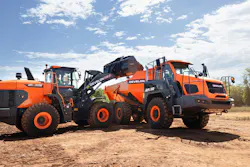
The Develon DL320-7 wheel loader is engineered for mid-size construction applications. What truly sets this machine apart is the integration of industry-exclusive Transparent Bucket 2.0 technology, now enhanced with AI-powered Object Detection. This system allows operators to “see through” the bucket to identify hazards and personnel in real time, significantly boosting jobsite safety. Performance is driven by a 7 percent larger bucket capacity and upgraded axles designed for high-volume material handling. For precision operations, the Smart Load weighing system tracks material weight instantly, while the Smart Guidance System provides real-time coaching to optimize operator performance. Built for maximum durability, the DL320-7 features a reinforced box frame and Situation Awareness Technology, which automatically adjusts engine output to balance power demands with fuel economy. Consistent uptime protection is further supported by the My Develon fleet management (telematics) system, providing seamless monitoring of machine health and location. For more info, visit Develon’s website.
Bobcat L95 wheel loader
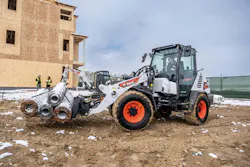
The Bobcat L95 wheel loader, the most powerful model in Bobcat’s wheel loader lineup, delivers strong performance for demanding construction and rental applications. Designed to move more material efficiently, the L95 offers a 3,981-pound rated operating capacity, a 1.2 cubic yard bucket, and a 10.5-foot lift height, along with travel speeds of up to 24 mph for fast jobsite travel. Power comes from a Tier 4 turbocharged engine that achieves emissions compliance without the use of a diesel particulate filter or selective catalyst reduction, helping reduce maintenance and downtime. The electronic hydrostatic transmission provides smooth operation and strong pushing performance, while standard high-flow auxiliary hydraulics support demanding attachments. The Power Bob Tach system enables quick attachment changes and select attachment sharing with other Bobcat equipment for even greater versatility. Operator focused features, including a low noise cab and automatic ride control, help reduce fatigue and support productivity throughout long workdays. For more info, visit Bobcat’s website.
Hitachi Construction Machinery ZW220-7 wheel loader
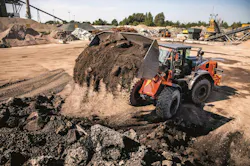
Hitachi Construction Machinery’s ZW220‑7 wheel loader is a core model in the company’s lineup. It can be used across a wide range of applications, including construction, infrastructure, agriculture, quarrying, and waste handling.
Specifications:
- Bucket capacity: 4.2 yards³
- Net engine output: 204 horsepower
- Operating weight: 40,013 pounds
- Breakout force: 32,625 pounds-force
It features Approach Speed Control, which sets a predefined travel speed as the wheel loader approaches a loading point. This reduces repeated pedal operation during loading cycles, improving fuel efficiency. The machine also has upgraded technology capabilities. ConSite supports remote monitoring and predictive maintenance, helping identify issues before they cause downtime. Payload Checker improves load accuracy and efficiency. Rear Obstacle Detection System improves site safety by giving operators immediate visual and audio alarms when they near an obstacle. This feature is standard on premium machines. For more info, visit Hitachi Construction Machinery Americas’ website.
Komatsu WA320-8 wheel loader
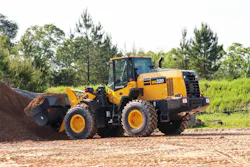
The Komatsu WA320-8 is a versatile mid-size wheel loader that balances strong performance with fuel efficiency. The hydrostatic transmission (HST) system is designed to enhance control by combining low- and high-speed motors. HST provides dynamic braking with single pedal control, improving operation on slopes while reducing brake wear and operator fatigue. The variable traction control system helps deliver solid traction and the electronically controlled suspension system provides a smooth ride, helping prevent material spillage. This unit also has good breakout force — engineered to assist operators in getting into dense or compacted material and achieve more consistent bucket fill. Combined with smooth, precise hydraulics, operators can load trucks, handle attachments, and carry material with greater control and less spillage, resulting in faster, more repeatable cycles. With bucket capacities ranging from 3 to 4.2 cubic yards and operating weights around 34,000 pounds, the Komatsu WA320-8 offers solid productivity in its class. For more info, visit Komatsu’s website.
New Holland Construction W100D wheel loader
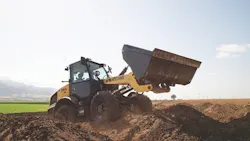
The New Holland Construction W100D stands out in the mid-sized wheel loader segment by delivering big-machine performance in a compact footprint. With 112 horsepower and an operating weight of nearly 20,000 pounds, it offers strong breakout force and lifting capability suitable for a variety of construction, landscaping, agriculture, and snow removal tasks. What differentiates the W100D is its operator-focused design. A fully redesigned cab improves visibility, space, and control, while features like a seat-mounted joystick, rearview camera, and intuitive electro-hydraulic controls enhance precision and ease of use. Its hydrostatic transmission and compatibility with a wide range of attachments further reinforce its versatility, making it a compelling choice among today’s mid-sized wheel loader options. Building on this success, New Holland Construction is expanding these cab enhancements across its entire wheel loader lineup this year, ensuring more operators benefit from the same elevated comfort, visibility, and control. For more info, visit New Holland’s website.
JCB 409 wheel loader
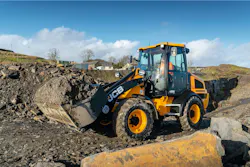
The JCB 409 wheel loader delivers mid-size loading performance in a jobsite-friendly compact platform. Powered by a 74 hp engine and weighing 13,296 pounds, the 409 is built for material handling, truck loading and stockpile work where maneuverability matters. It offers a bucket capacity of up to 1.3 cubic yards and a payload capacity of 4,021 pounds, giving contractors the ability to move serious material without stepping up to a larger frame size. An articulated pivot-steer design supports a tight turning radius, making it well suited for confined yards, landscape supply operations and municipal work. Hydrostatic drive provides smooth modulation and precise control for repetitive loading cycles. A single-piece hood allows ground-level access to service points, and available telematics support helps track machine hours and maintenance intervals. For contractors looking for a loader that balances power, transportability, and visibility, the 409 delivers production without excess footprint. For more info, visit JCB’s website.
Case 421G wheel loader
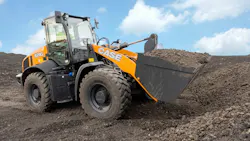
Case Construction Equipment’s 421G wheel loader provides more operator comfort while balancing agility and heavy-duty performance for demanding jobs. Powered by a 112-horsepower engine, it provides strong torque and breakout force for handling tough materials, along with a straight tipping load rating of 14,718 pounds and a 145-inch hinge pin height for reaching taller trucks, bins, and hoppers. The elevated hinge pin also improves visibility to attachments and the work area. Operator comfort and control are central to the design. The cab features double-sided doors, adjustable seating and armrests, 270-degree visibility, and seat-mounted electro-hydraulic controls. Operators can fine-tune lift and tilt responsiveness to match specific tasks. A standard JRB-compatible coupler enables quick attachment changes from the seat. The hydraulic system enhances efficiency with load sensing and flow sharing, while an optional high-flow setup supports specialized tools. A hydrostatic transmission also offers shift-on-fly capabilities for smoother operation and seamless gear transitions. Ground-level service access minimizes downtime and simplifies maintenance. For more info, visit Case’s website.
Volvo L220 wheel loader
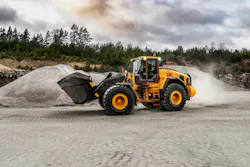
The Volvo CE next-gen L220 wheel loader is a heavy-duty powerhouse for rehandling, quarrying, waste applications, and more. It features Volvo-exclusive Automatic Traction Control that engages a 100 percent differential lock when needed to maximize grip while reducing tire wear and fuel consumption. Updated load-sensing hydraulics increase responsiveness and boom speed to shorten cycle times, while Auto Bucket Fill and bucket leveling save even more time by automating repetitive tasks to minimize rework and operator fatigue. Efficiency is further enhanced by OptiShift technology, which pairs a lock-up torque converter with Volvo’s patented Reverse By Braking function. This system reduces engine rpm and automatically applies brakes during direction changes, eliminating power loss and improving fuel efficiency by up to 15 percent. For enhanced jobsite safety, the L220 also offers an optional Collision Mitigation System that actively alerts operators to unseen obstacles. For more info, visit Volvo’s website.
Caterpillar 950 and 980 wheel loader variations
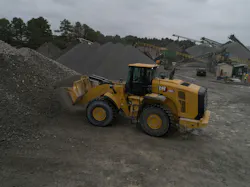
Caterpillar’s medium wheel loader portfolio is differentiated by a deliberate, tiered offering designed to meet a wide range of customer needs, applications, and business objectives. This strategy began in the 950 size class (950 GC and 950) which happens to be the most popular size class for medium wheel loaders. This strategy has continued to expand, most recently into the 980 size class. At the foundation of the lineup, standard GC models are built on proven Caterpillar designs with traditional features. These machines are robust, durable, and straightforward to operate. Above that, Caterpillar’s Next Gen performance powershift and premium XE models are engineered to deliver the lowest cost per ton moved, offering the most comprehensive feature sets and specialty packages in the lineup designed to help the operator(s) use the iron more efficiently and effectively. Advanced smart technologies such as Operator ID, application profiles, and on‑screen job aids, combined with assist features like machine speed limits, auto‑set tires, auto‑dig, and tip‑off assist, help drive consistent productivity across operators. These models also include standard Cat Payload, with scalability to advanced payload solutions.
Safety is equally intentional. The latest addition to these models — the Collision Mitigation System with Automatic Emergency Braking — reinforces Caterpillar’s safety focus. This tiered philosophy now extends across the 980 lineup, with the new 980 GC joining the 980 powershift and 980 XE, giving customers more choices. For more info, visit Cat's website.
About the Author
Keith Gribbins
Keith Gribbins is the head of content at Construction Equipment, where he leads editorial strategy across print, digital, video, and social channels. An award-winning journalist with more than 20 years of experience, Keith has won 17 national and regional editorial awards and is known for his hands-on reporting style, regularly visiting manufacturers, operating equipment, and covering major industry events worldwide.