The MT500: Vermeer Built a Machine to Automate Solar Pile Layout
Key takeaways:
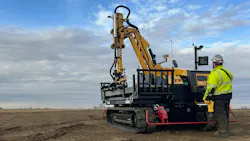
- One operator handles pile layout: GPS and automation help the MT500 place 400-pound solar piles at designated waypoints.
- Automation simplifies the work cycle: One button replaces up to 12 operator inputs and places piles within a 6-inch diameter.
- Pile driver technology provided the foundation: Vermeer built the MT500 using components and technology from its PD25 solar pile driver.
Solar farms may represent the future of energy, but building them hasn’t exactly been the pinnacle of modern efficiency. For instance, crews still use skid steers and telehandlers to shuttle bundles of steel piles across sprawling jobsites before manually laying each one near its GPS waypoint. It’s slow, labor-intensive work.
“These things can be up to 400 pounds apiece,” explains Ed Savage, product manager at Vermeer. “Using a skid steer or telehandler, crews are just trying to get these piles close to this waypoint, which is a GPS coordinate on a digital map. It’s not always the most accurate way to do it. They get it close. Then, the pile driver crew has to pick it up and then drive it into the ground. For starters, it’s obviously a big safety risk and then it’s a lot of extra manual labor. When they go out there and lay these piles out, they call it ‘shakeout’ — it’s kind of an industry term.”
The Vermeer brand has spent more than a decade helping solar contractors pound piles into the ground with its line of four pile drivers (the PD5, PD5R, PD10, and PD10R), but now the company wants to fix what happens before the pile driver arrives. The new Vermeer MT500 material transporter automates the pile layout, or shakeout, process on utility-scale solar jobsites. One operator can load the machine with W-beam piles and send them to GPS-defined locations across the solar field. There’s really nothing like this on the market right now.
“Some people have made attempts at it — mainly European manufacturers — because some of our pile driver competitors are European-based,” says Savage. “They’ve tried it but just haven’t commercialized it yet for whatever reason. So, this will be one of the first commercially available ones on the market.”
How does the Vermeer MT500 work?
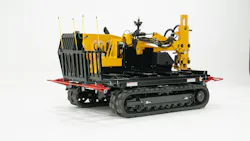
Pile layout is one of the first major steps in utility-scale solar construction. Before crews install trackers and panels, pile drivers must put thousands of structural piles into the ground. First, somebody has to get those piles into position. Traditionally, crews use a compact tool carrier like a track loader or telehandler to carry bundles across the site. Workers then lay individual piles near GPS waypoints. Vermeer has been in the pile driver business for roughly 13 to 14 years. During that time, the company repeatedly heard complaints.
“Something we hear a lot from pile driving crews is that layout accuracy can be hit or miss,” says Savage. “Piles get set, but the tolerances aren't always where they need to be.”
Consider that on a typical large project, a job might run 10 to 15 pile drivers. The MT500 attacks that bottleneck with automation. Its adjustable pile rack handles 10- to 25-foot W-beam piles and carries up to a 5,000-pound payload. That capacity typically accommodates the pile bundles delivered to solar jobsites. A hydraulic gripper uses two mechanical pads to grab each pile. Vermeer tested magnets during the development process but ultimately selected the mechanical gripper. The MT500’s rated maximum pile weight is 400 pounds.
One button replaces up to 12 operator inputs
The MT500’s most interesting feature is its automated work cycle. Laser sensors identify the closest pile in the stack. The arm grips the pile, pulls it from the rack, and places it at the proper GPS waypoint. The machine then raises the arm and automatically tracks to the next location.
One button starts this entire sequence. Completing those functions manually could require 11 or 12 separate operator inputs, according to Savage.
“It’ll also place it within a 6-inch diameter, so it’s very accurate,” he says. “You can select how far you want the end of the pile from that. So, when the pile driving crew comes along, they don’t write where to wrap it and lift it up to drive it. So, accuracy was really important to us, and then just the moving of the machine too.”
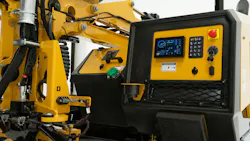
The MT500 uses point-to-point and row-to-row automation developed from Vermeer’s pile driver technology. The operator still monitors the machine and initiates each cycle, but the system handles the repetitive motions. As far as controls, the MT500 shares the same on-machine display as the Vermeer PD25R pile driver. During operation…
“It’s all remote-controlled,” says Savage.
Of note: Vermeer designed the MT500 for third-party GPS systems. The company does not sell the GPS hardware directly but works closely with Carlson and Trimble. Dealers typically integrate the contractor’s preferred GPS technology.
MT500 safety technology monitors the travel zone
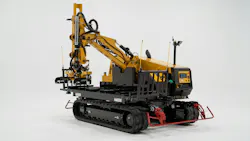
Automation changes how operators and ground crews interact with equipment. Vermeer added several systems to alert workers and monitor the MT500’s surroundings.
- Amber beacon: Flashes when the MT500 operates in remote-control or automation mode.
- Mechanical bump bars: Physical object detection at both ends stops the machine if it contacts an obstacle, such as a stump or installed pile.
- LiDAR object detection: Detects objects in designated travel zones and automatically slows or stops the MT500 based on proximity.
- Ultra-wideband wireless remote: Controls all machine functions and includes a standard emergency stop. Vermeer designed the system for line-of-sight operation.
- Familiar controls: The remote closely resembles the PD25R pile driver controller, potentially reducing the learning curve for existing Vermeer solar crews.
Built for mud, soft ground, and long solar rows
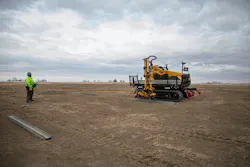
Solar jobsites are not always flat, dry fields. Vermeer learned that lesson with its pile drivers and carried it into the MT500’s design. Rubber tracks limit ground pressure to 6.4 psi. The machine also provides 12 inches of ground clearance for mud, ruts, and uneven terrain. A 74-horsepower Tier 4 Final/Stage V Rehlko engine powers the MT500. The engine does not require diesel exhaust fluid. The 35-gallon fuel tank is sized for nine hours.
“That’s enough for a normal operating shift — that nine-hour window,” says Savage. “And then transport mode. Really all you have to do is position the arm into transport mode, and that’s all done via remote control when you’re ready to transport.”
In transport mode, the MT500 measures 88 inches wide and 187 inches long.
Vermeer pile drivers opened the door
The MT500 is only Vermeer’s second machine category developed specifically for solar construction. Its pile drivers came first. To engineer the MT500, Vermeer began with the PD25 pile driver platform and used its chassis as a foundation for the new material transporter.
“If you set them side by side, you’ll notice the engine pod, all the shielding, and the engine hydraulics are all the same on both machines,” noted Savage. “So, you think of a customer with a mixed fleet of both machines, all their service items are the same. The filters, the air filters, oil filters, where the service points are. So, it’s just very common there. The undercarriage is identical on the PD25. So, it’s not only nice for us manufacturing having the commonality, but from the customer perspective and training people on either machine, it just eases that.”
As far as on-rig diagnostics, the MT500 uses the same on-machine display as the PD25R. Vermeer has also connected the MT500 to its VermeerOne platform. Fleet managers can monitor machine data and use telematics to manage maintenance and performance. That becomes more important as solar contractors move crews and equipment across the country.
Major contractors helped shape the MT500
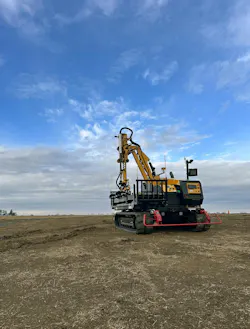
Vermeer brought major solar contractors into the MT500 development process early. Bechtel, Blattner, and Kiewit reviewed early concepts and helped Vermeer narrow the machine’s specifications. The feedback also exposed a challenge: The MT500 changes an established workflow. Some contractor leaders initially struggled to see exactly where the machine would fit.
“Trying to change human mindsets, sometimes it’s challenging,” says Savage. “We had it out and demoed it on a jobsite here about two weeks ago. The operators absolutely loved it, but the general superintendent said at one point he didn’t know if they’d use it. Eventually he said, ‘I see it now.’ Once he saw it on the jobsite, then the wheels started turning.”
Since we’re all thinking outside the box, the platform could potentially handle different products with changes to the arm or end effector. The current hydraulic gripper is designed for W-beam piles, but the basic machine offers flexibility for other applications.
“We’ve got people asking for other versions of it to lay out other pieces or components on the site,” says Savage. “So yeah, there’s a possibility. I mean, the platform is flexible enough with some changes to the arm and gripper. So yeah, who knows where we’ll end up with it in the future if there’s a big enough market.”
Vermeer MT500 specifications
- Pile length capacity: 10 to 25 feet
- Maximum individual pile weight: 400 pounds
- Maximum payload: 5,000 pounds
- Engine power: 74 horsepower
- Engine emissions: Tier 4 Final/Stage V
- Fuel capacity: 35 gallons
- Ground pressure: 6.4 psi
- Ground clearance: 12 inches
- Transport width: 88 inches
- Transport length: 187 inches
- Undercarriage: Rubber tracks
- Operation: Full-function wireless remote control
- Pile type: W-beam piles
About the Author
Keith Gribbins
Keith Gribbins is the head of content at Construction Equipment, where he leads editorial strategy across print, digital, video, and social channels. An award-winning journalist with more than 20 years of experience, Keith has won 17 national and regional editorial awards and is known for his hands-on reporting style, regularly visiting manufacturers, operating equipment, and covering major industry events worldwide.