JCB Enhances Skid Steer Lineup with 250, 290
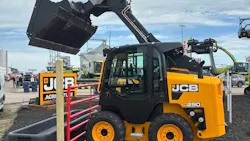
JCB's skid steer line, with its single-arm design, playfully dubbed "the one-armed bandit," is back in the news with two new models on the lower end.
The British company has launched the 250 and 290 skid steers, manufactured in Savannah, Georgia, and powered by a 74-horsepower engine.
The machines are engineered to support a wide range of attachments and tackle daily jobs across the jobsite, from loading trucks and moving pallets to grading, site cleanup, and material handling.
Of course, the single-arm models are also known for their safety-driven side-door entry, which ensures the operator is not climbing over buckets or attachments to enter the machine. No other OEM offers this feature.
"North American contractors continue to face labor shortages, making every employee and every piece of equipment more important than ever," says Lee Tice, senior product manager – Compact Equipment, JCB North America.
Watch JCB's 400-mph land missile
"The new 250 and 290 skid steer loaders are designed to help a single operator accomplish more throughout the day. Our industry-exclusive side-door entry eliminates the need to climb over buckets, pallet forks and other attachments every time operators enter or exit the machine," Tice says. "It's a smarter design that improves productivity, enhances safety, and helps operators keep work moving."
There is no loss of power with the single-arm design, either; Construction Equipment put that notion to bed a long time ago.
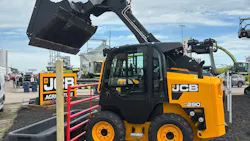
Features and specs
The 250 and 290 offer rated operating capacities of approximately 2,531 and 3,029 pounds, respectively, with hinge pin heights reaching more than 10 feet. That combination provides the reach and lifting capability needed for loading trucks, handling palletized materials, moving bulk aggregates, and placing jobsite supplies.
How to maintain skid steer tires
High-flow hydraulic options and compatibility with a broad range of skid steer attachments allow operators to tackle virtually any material handling task with a single machine.
Despite their capability, both models maintain a compact footprint and excellent maneuverability. Operators can work efficiently around residential jobsites, commercial developments, landscape projects, and other confined work areas where larger equipment may not fit.
About the Author
 Frank Raczon
Frank Raczon
Frank Raczon has influenced and covered the equipment industry for 35 years, including 15 years as senior editor of Construction Equipment, and marketing, advertising, and public relations work for the industry's top manufacturers. He authored "Caterpillar: Modern Earthmoving Marvels" (Motorbooks, 2015), and has won numerous awards in his career, highlighted by nods from the Construction Writers Association, the Association of Equipment Manufacturers, the Business Marketing Association, and BtoB magazine. Raczon has also won awards from publishing peer groups such as ASBPE and TABPI.