This 22.6-Ton Prinoth Crawler Carrier Was One of Conexpo’s Wildest Machines

I just got back from Conexpo, and only the coolest equipment earns such early copy. So, I’ll start months of coverage with a monstrous crawler carrier. This mechanized beast packs a 22.6-ton payload and a patent-packed undercarriage dubbed the “PowerForce.” The West Hall at Conexpo was full of interesting machines, but one of the wildest sat inside the Prinoth booth. It was the new Panther T23r rotating crawler carrier, and it looked ready to roll over mountains. New Prinoth CEO Marc Lepage took to the stage at Conexpo for the unveiling.
“This piece behind me — a lot of labor went into it,” said Lepage. “For those that know OEMs, there's a lot of testing and designing and retesting and redesigning just to get it right. We wanted to make this machine perfect. We wanted it to have high productivity. We wanted more work. We wanted faster. We wanted it to be top quality, minimizing downtime. And we wanted it to be absolutely comfortable for your operators. I think that we nailed it.”
The Prinoth Panther T23r crawler carrier overview
Prinoth is touting the Panther T23r as the “industry’s largest and most technologically advanced rotating crawler carrier,” according to the press release. Prinoth unveiled the machine at Conexpo with heavy equipment influencer Bryan Furnace and Panther product manager Frank Gangi. The reveal drew a sizable crowd — because the unit looks absolutely gnarly. The Panther T23r combines a big payload, rotating upper structure, new undercarriage design, and a sleek silver-and-black badass vibe.
Prinoth noted that the T23r claims the largest payload in its class at 22.6 short tons. Yet the machine stays surprisingly compact. The carrier measures about 9.8 feet wide and 10.4 feet tall and weighs roughly 23 tons. Its continuous 360-degree rotating upper structure and Hardox steel dump box (engineered with a telescopic cylinder) enable precise material placement in confined spaces. It tops out at 10.9 mph. This is a serious off-road hauler built for steep slopes, soft ground, and tight work zones. Think pipeline jobs, remote construction sites, forestry operations, and sensitive terrain where wheeled trucks struggle.
What is the Prinoth PowerForce undercarriage?
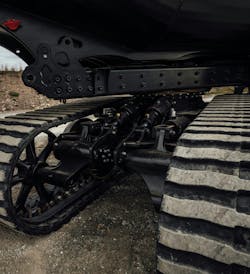
The company calls its unique undercarriage the PowerForce. It embraces a variety of interesting design elements.
“It's designed for maximum terrain performance, enhanced operator comfort, and extended operating range,” explained Gangi. “We do that in a number of different ways. For instance, this undercarriage suspends every single wheel independently with 7 inches of travel. You can imagine how that improves your traction. First and foremost, keeping that track on the ground regardless of the obstacles that you're going over. And then it also helps protect the operator because the undercarriage is taking the impacts and it also protects your machine components again, because the undercarriage is taking those impacts. It is completely independent for ultimate comfort.”
Prinoth noted that traditional crawler carriers often use rigid walking beams. Those systems transfer terrain bumps directly into the machine and operator. PowerForce takes a different approach. It uses independent suspension arms combined with hydro-pneumatic shocks. The system absorbs terrain changes while keeping power flowing to the tracks. Prinoth says the technology is tied to more than 20 patent applications.
Key PowerForce design elements include:
- Independent suspension arms: Eight wheels sit on separate arms with 7 inches of travel.
- Hydro-pneumatic shock absorbers: These adjust automatically to load conditions.
- Dual ride settings: The system maintains comfort whether the carrier is empty or fully loaded.
- Optimized weight distribution: About 60 percent of the load rides on the center wheels. That weight distribution helps improve zero-turn capability and reduce ground pressure. It also protects both cargo and machine components on rough terrain.
New track geometry improves traction and efficiency
Prinoth engineers also rethought the track layout. The T23r uses an oblong track configuration rather than a traditional circular design. The oval layout reduces track bend points by 50 percent. This geometry reduces energy loss and also increases ground contact area.
“The track shape is one of the key areas that we really focused on,” said Gangi. “Tracks are very difficult to bend. It takes a lot of energy to do that. So, the traditional undercarriage is trapezoidal. We took two of those bends away. We also doubled the bend radius, so we’ve increased efficiency by about 200 percent. So now that power is not used to bend the track. It's used for work on the ground.”
Other track features include:
- Precision track pitch: 10 times greater alignment accuracy than standard crawler carriers, according to Prinoth.
- Auto-centering track profile: A “fox head” design keeps the track aligned with the drive sprocket.
- Planetary drives: These engage 15 teeth at once instead of a single contact point.
- Automatic tension system: Track tension adjusts automatically based on load and terrain.
A rotating crawler carrier built for tight terrain
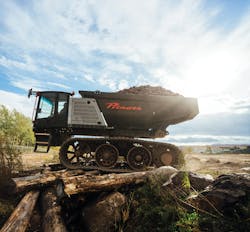
Crawler carriers already excel in difficult ground conditions. The Panther T23r adds another advantage. The entire upper structure rotates 360 degrees. That rotation allows operators to dump material in any direction without repositioning the machine. Crews can stay planted while placing rock, dirt, or aggregate exactly where it needs to go.
“We also rounded the edges [of the dump box] made out of Hardox material,” noted Gangi. “That helps reduce the weight and structure needed for support. It gives us more payload. It also reduces carryback so you're not moving the same material back and forth. It gets out of the machine really quickly.”
Prinoth also moved the dump box closer to the machine’s centerline. That shift improves weight balance across the chassis and suspension system. It also reduces structural stress on the frame.
Panther T23r operator cab: designed for visibility and comfort
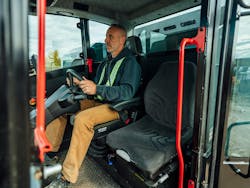
Prinoth also redesigned the cab for the Panther T23r.
“We designed this cab to be about centered on the machine,” said Gangi. “Maybe not quite, but pretty close to center. So, your visibility out the front, out the left, out the right, is very good. We also have good visibility with the mirrors, and we have two cameras — one on the right side and one on the rear. So, sight all around the machine is excellent.”
Some other standard cab features include:
- Air-ride operator seat
- 7-inch touchscreen display
- Ergonomic joystick controls for dumping and rotation
- Steering wheel and foot-throttle drive system
- Sun visor and cruise control
- An optional buddy seat allows another worker or supervisor to ride along when needed
A serious new hauler enters the crawler carrier market
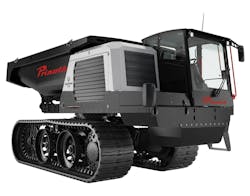
The Panther T23r shows where crawler carriers are heading. Bigger payloads. Smarter suspension. More operator control. With its rotating upper structure, 22.6-ton payload, and patent-heavy undercarriage, the T23r looks ready for the toughest jobsites. And if the reaction inside the Prinoth booth at Conexpo is any indicator, this gnarly carrier makes a pretty strong first impression.
“[Contractors have] a lot of unique challenges, and most crawler carriers are going to address maybe one or two of those,” explained equipment influencer host Bryan Furnace. “This machine's going to address all of those challenges simultaneously. This machine's going to change the way that the load is transferred to the ground. It's going to change the way the track stays engaged with the ground over uneven terrain. It's going to change the way this engine takes raw horsepower and transfers it to the ground in forward momentum. It's going to change the way the operator experiences today. And finally, it's going to change how much work we can get done on a tank of fuel and how quick we can get back to work after regular maintenance.”
About the Author
Keith Gribbins
Keith Gribbins is the head of content at Construction Equipment, where he leads editorial strategy across print, digital, video, and social channels. An award-winning journalist with more than 20 years of experience, Keith has won 17 national and regional editorial awards and is known for his hands-on reporting style, regularly visiting manufacturers, operating equipment, and covering major industry events worldwide.