Inside Caterpillar's Hands-On Road Builder Pro Training Program
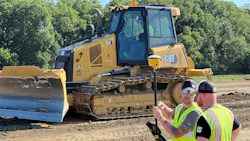
If you've ever had the pleasure of visiting Caterpillar's Edwards, Illinois, Demonstration and Learning Center, you get a sense of how important customer training is to the company.
There are many acres of earth to dig, move, and grade, tons of machines, and even simulators. There's also a large staff of professional instructors.
But what you might not know is how thorough and specific the programs are.
In a former job, I attended a session at Edwards for National Cemetery Administration workers. That's right, the grave diggers and other workers who take care of some of the country's most hallowed ground, including Arlington.
It was far more than six-foot excavations — it included safety, walk-around inspections, start-up and shut down procedures, operation, lifecycle costing, procurement, and more — with every relevant machine.
As a result, I knew going in that the Road Builder Pro training would be good, but I had no idea how comprehensive it would be.
Let's build a road
Caterpillar's Road Builder Pro courses started in 2012 for Cat dealers only so that sales professionals would know more about the customer experience. By 2017, the course was expanded to customers recommended by dealers.
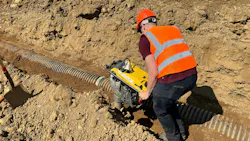
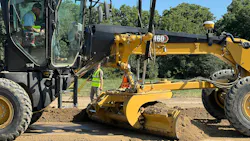
It is a five-day course that splits attendees into two 10-person teams, both of which end up building a 250-foot road bed complete with proper base, crown, precisely sloped shoulders, and drainage, topped by aggregates.
"Eighty percent of the course is hands-on," says Lonnie Fritz, senior market professional, construction industries, for Caterpillar. "We also start by building the traditional way [think traditional measurements and Dynamic Cone Penetrometers], and then we add in technology."
That means features like Cat Grade and payload weighing.
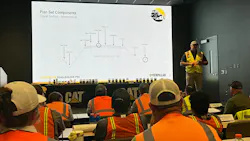
Classroom instruction included industry terms, estimating and bidding, plan reading, technology used in the industry, project management, soils and compaction, and more. Only then is time to go into the field.
How to lay firm foundations for road building
"I think most of us would agree that we learn by doing, by seeing, by getting our hands dirty, by putting on our boots and our vest and our safety glasses,"
Fritz says. "And then getting out here after putting that seatbelt on and actually cutting a ditch, putting down some aggregate base course, tracking true job cost, and seeing how profitable we are — all while doing it safely."
Teams are divided up into a project manager, a superintendent, a dirt foreman, a pipe foreman, laborers, operators, quality control inspectors, and safety marshals.
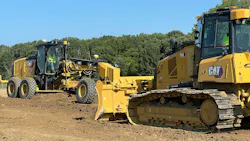
"On the second day, the participants rotate through eight different stations," Fritz says. "Six of those stations involve machine operation, the best practices for the operation of those machines, and utilizing the technology on those machines such as grade, payload, and compaction.
There's also grade checking and construction layout, which needs to be done with and without technology.
"The final station is the project management station where we go through all the documents they have, the minimum safe working requirements, toolbox talks, the bid notes, the bid submittal, the resource requesting forms for requesting water [tankers], bedding material, the pipe and aggregate base course they need, and all the other tools and supplies to build this road," Fritz says.
Caterpillar, Rio Tinto partner for autonomous technology
Some of that paperwork returns to prominence at the end of the course, when both teams go through a presentation and evaluation process back in the classroom.
If it sounds like a lot, it is. But students went from station to station with enthusiasm, purpose, and best of all, retention.
Students speak
"I've learned quite a bit, actually," says Bronson Barson, equipment manager for Fisher Sand and Gravel, Tempe, Arizona. "For me, I get a lot of calls from the field requesting different types of equipment, so it's a logistics game for me to figure out."
"Now I have a little better understanding so I can ask better questions of the guys in the field, maybe about machine specifications they might need," Barson says. "And then I can also come up with some other solutions if we don't have exactly what they're looking for."
Barson says he gained a better understanding of what colleagues are talking about when they discuss subgrade and final grade, and refer to plans.
"I would recommend it," Barson says. "It's a week. You're not going to come out of here an expert, but it's definitely going to give you the foundation to better understand construction and equipment and how to move dirt with the challenges you run up against — from material placement on the job site to different machines. And you've got multiple machines running at once, so you've got to coordinate that and try to be as effective as possible."
Back-office benefits
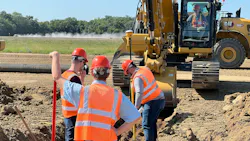
Magdalene Khan is an estimator for Morgan Corp. a heavy civil contractor in the Southeast and took the training. You wouldn't necessarily picture that job title in the trenches or operating a backhoe dumping fill.
"I think one of the biggest values that you'll ever get working in construction is to actually get a bit of field experience," Khan says. "I'm very lucky that Morgan Corp. selected me to come do the Road Builder Pro course and really see what a job is like from start to finish in addition to what we do on a daily basis."
Khan says she has gained knowledge to enhance her estimating work.
"When you go through the estimating process, you really have to think about the big picture and what your guys out in the field are going to need," she says. "And so the budget that they gave us was really in-depth. It told us exactly what we were going to be doing. It was a very thorough process that they gave us and they were able to explain it really well."
"They gave us the rundown, the plans, and the budget, so we knew exactly what we were going to do when we came out here," Khan says.
Bottom line results
As every fleet manager knows, if you can't measure it, you can't manage it. Progress and costs are both measured at the end of the Road Builder Pro course.
That end comes wherever the project is at at 11:30 am on Friday, and it's inspection and reporting time for both groups.
"The participants take all that data from the dirt for each of seven pay items, including labor, material, and equipment, based on the pay item they're working on, and they compile all that data to get to a total cost per item," Fritz says.
"What I ask the participants to do then is provide me a report-out presentation," Fritz says. "What was your schedule? What went well? What was your true cost per pay item compared to budgeted cost? What lessons did you learn?"
Much like in "real life," success is measured by the numbers.
"We then compare that to our actual revenue from the project using all those unit prices times the units of work put into place, we can then calculate our profitability in the percent of profit," Fritz says.
"It is so great to see the participants get up there on stage and share what they have learned as they've worked together as a team."
About the Author
 Frank Raczon
Frank Raczon
Frank Raczon has covered and influenced the equipment industry for 35 years, including 15 years as senior editor of Construction Equipment, and marketing, advertising, and public relations work with the industry's top manufacturers. In addition to authoring "Caterpillar: Modern Earthmoving Marvels" (Motorbooks, 2015), he has won numerous awards in his career, highlighted by nods from the Construction Writers Association, the Association of Equipment Manufacturers, the Business Marketing Association, and BtoB magazine. Raczon has also won a number of awards from publishing peer groups such as ASBPE and TABPI.