No More Waiting: Real-Time Fluid Analysis Is Indeed Real
You may have heard of "The Omen," and of course its sequel, "Damien – Omen 2." ("Omen III: The Final Conflict" was just bad.)
Now comes the decidedly less evil Omen AI, which calls itself a continuous fluid analysis company. And that's just what it is.
Omen AI uses fluid analysis to read the health of equipment such as servers in data centers and industrial machines (ding ding ding!), so managers and owners know what's failing before it fails, without waiting on quarterly lab tests.
Equipment Executive: Tackle fluid contamination
The company's sensors attach directly to a machine's fluid system (oil, coolant, or water) and deliver continuous, real-time analysis of metal content, bio-contaminants, wear patterns, and fluid degradation.
"I started working with heavy equipment manufacturers as a teenager and watched machines fail because of the antiquated methods the industry uses for monitoring fluid health," says Zach Laberge, founder and CEO of Omen AI.
"Taking a sample, shipping it to a lab, and waiting days for results is dangerously inadequate when you're protecting operating industrial machines and billions in GPU infrastructure" Laberge says.
"Omen AI was built to prevent catastrophic failure. We help data centers push their hardware to the absolute limit, unlocking compute performance operators didn't know they had, and enabling industrial machine operators to prevent costly failure."
How does Omen AI work?
Omen has two key elements that work together to instantly gather and analyze data:
- Permanent sensor: Connects directly to the machine's fluid system with a one-time, non-invasive installation. Continuously tracks metal content, bio contamination, and wear patterns, building a health trajectory over time.
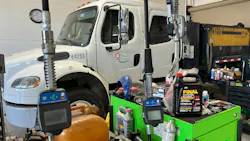
- Portable diagnostic unit: Delivers the same spectroscopic precision in a unit technicians can bring to any machine, on-site or in the field, for an immediate diagnosis.
Both form factors analyze 21+ elemental signatures simultaneously, replacing the sample-and-wait model with continuous, real-time data.
Users pay for Omen AI per machine, per year. "This is similar to how labs price fluid testing," Laberge says. "It's a predictable line item that scales cleanly with the size of the fleet.
How to set fluid contamination flagging limits
Who's using it?
Industrial fleet operators have already signed on, including Carolina Cat.
"Carolina Cat is running Omen AI across their rental fleet today, with a clear path to deploying it on customer machines next," Laberge says. "We monitor those assets for two things: catastrophic failures before they happen, and the gradual wear on the expensive components: hydraulic wear, engine oil degradation, and the like that quietly drives up cost of ownership."
Then there are the data centers that represent $200 billion in assets operating 10 to 14 GW of capacity where Omen AI monitors coolant health in real time.
The company says these customers together generate $150 billion in revenue and operate more than 2 million machines.
"Whether it's a liquid-cooled AI infrastructure or a fleet of industrial machines, the cost of an unplanned failure is staggering," says Cory Rellas of Nava Ventures, an Omen AI investor.
"Despite the high stakes, these systems are still monitored with lab tests that take days. Omen AI built the solution: continuous, real-time visibility into the health of the machines doing the world's most critical work. Zach and his team aren't just building a better sensor; they're building the nervous system for the machines powering the modern world," says Rellas.

About the Author
 Frank Raczon
Frank Raczon
Frank Raczon has influenced and covered the equipment industry for 35 years, including 15 years as senior editor of Construction Equipment, and marketing, advertising, and public relations work for the industry's top manufacturers. He authored "Caterpillar: Modern Earthmoving Marvels" (Motorbooks, 2015), and has won numerous awards in his career, highlighted by nods from the Construction Writers Association, the Association of Equipment Manufacturers, the Business Marketing Association, and BtoB magazine. Raczon has also won awards from publishing peer groups such as ASBPE and TABPI.