Smart Compaction Gets Smaller: Intelligent Compaction Moves Down to Walk-Behind Equipment
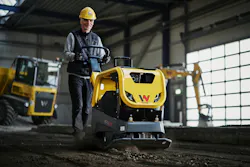
Compaction has always had a little black magic in it. You make a pass. Then another. Then maybe one more. You know, just to be safe. Luckily, compaction technology has brought more science to the dark arts of asphalt and dirt work. Intelligent compaction (for instance) can be fitted to a machine (usually asphalt and earth rollers) using sensors, GPS, and onboard computers, to measure soil or asphalt density in real time. Some systems can also utilize machine control and automatically guide operators to achieve optimal compaction. Usually, this tech is used on long-haul roller projects like highways and airports, but lately we’ve seen intelligent compaction tech showing up on walk-behind compaction equipment.
Intelligent compaction in plates and rollers
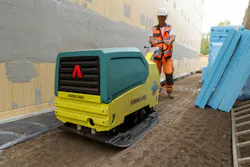
Walk-behind plates and trench rollers are productivity powerhouses. Trench backfills. Utility cuts. Asphalt patch work. Landscaping base prep. Wave in the walk-behind compaction equipment. These are often not glamorous jobs, but efficiency and quality control are equally important on them. Plates and trench rollers create dense, durable foundations for soil, asphalt, and granular material like crushed stone. These excellent machines could benefit from cool IC tech, just like their bigger brothers.
Of course, the new wave of intelligent compaction for walk-behind machines does not look exactly like the high-end systems found on asphalt rollers and drum compactors. You will not get full GPS mapping, automated machine adjustments, or a giant in-cab display. You also won’t get that big price tag. This is mostly indicate-only light bar technology. But you do get something very useful: simple, real-time feedback that helps operators know when to make another pass and when they are just burning fuel while beating up the machine. Let’s look at what’s on the market today.
BOMAG’s approach: The Economizer keeps it simple
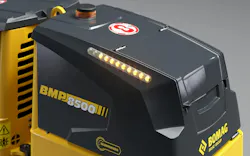
The roadbuilding world has been the proving ground for intelligent compaction. Single-drum soil compactors, tandem asphalt rollers, and pneumatic rollers have used IC systems for years. Big compaction brands offer lots of different types of intelligent compaction options for their bigger machines. Let’s use BOMAG as an example. The company offers Bomap (a GPS-based app to monitor compaction in real-time on any roller), Asphalt Manager (automatically adjusts asphalt vibration direction based on material stiffness), and Variocontrol (automatically adjusts a drum’s direction from vertical to horizontal). On the lower end, BOMAG’s Economizer product is a simplified IC tool that uses light bars to indicate the current level of compaction and identify weak spots in the subgrade.
“BOMAG offers the Economizer as an optional feature across several models within our light equipment portfolio,” says Ruben Garcia, BOMAG product marketing manager for single drum rollers, light equipment, landfill, and heavy soil compactors. “It’s available on our reversible plate compactors, including the BPR 50/55D, BPR 60/65D, and the heavier BPR 70/70D. Beyond reversible plates, the Economizer is also offered on our world-renowned multipurpose roller — the BMP 8500.”
The Economizer uses an onboard accelerometer to measure surface response from vibration. The operator sees progress through a row of indicator lights. As compaction improves, more lights illuminate. Simple, right? When the lights stop increasing on later passes, the operator knows the material has likely reached its maximum practical compaction level for that machine and soil type.
“If the operator goes over a soft spot, like a wet clay area, the Economizer value would drop significantly,” explains Garcia. “If, on the other hand, the operator went over a large buried rock or boulder, a sudden increase in Economizer value would be expected. This system helps prevent over-compaction, eliminates unnecessary passes, and improves efficiency. It also identifies weak spots.”
No need to count passes or chase a target speed. Just compact as normal and watch the lights. Of course, BOMAG does not pitch the Economizer as the answer for every light compaction unit.
“By treating our customers’ challenges as our own, we have gained valuable insights directly from the field,” says Garcia. “These insights have helped us understand which models benefit most from the Economizer and where it delivers the greatest value. We have also learned where the Economizer is not essential. For example, due to the specific applications in which tampers and single-direction plates are used, the Economizer does not provide the same added benefit on these machines.”
Ammann’s approach: ACE and a smarter plate motion
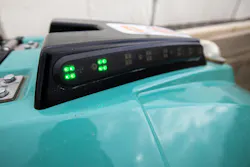
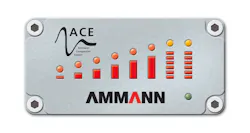
Ammann brings intelligent compaction to walk-behind equipment with its ACE Systems on trench rollers and medium-to-heavy reversible plates. The concept is straightforward. ACE measures relative compaction value, then gives the operator continuous feedback through an LED display. It shows whether compaction is still improving between passes and helps signal when the machine has reached the maximum achievable surface density for that setup.
“ACE for vibratory plates measures the load-bearing capacity of the compacted layer by applying defined force and frequency, then analyzing the frequency response spectrum,” says Thiago Santos, head of used equipment and area sales manager of light equipment and commercial management light at Ammann. “An onboard algorithm qualitatively calculates soil stiffness in real time. The system is advisory only; it does not automatically adjust amplitude or frequency.”
Like Bomag’s Economizer, a light bar is used to give feedback. “When there is no progress shown on the LED panel, it means that the maximum achievable surface density has been reached with this machine size,” says Santos. Ammann says the system is built on the same core technology used in its larger compaction machines under brand names like ACE or its more advanced ACE Force and ACE Pro systems.
“The ACE system is available for all Ammann trench rollers and medium-to-heavy reversible plates — especially for soil and granular materials,” says Santos. “Direct feedback from the compaction sensor is easily readable on the machine compaction display. This technology is ideal for confined areas such as trenches, utility cuts, and small patches where per-pass feedback is valuable. It’s not ideal for very small rammers and handheld units where space constraints and vibration environments limit effective sensor integration.”
Ammann also highlights its triple-shaft exciter system on reversible vibratory plates. That is not intelligent compaction in the data-feedback sense, but it supports the same goal: more controlled, repeatable results. The added exciter shaft on a triple-shaft system helps balance the machine travel more smoothly in heavy, cohesive soils, and it helps units climb grades better.
“The triple-shaft exciter system also improves compaction of heavy soils and thick layers through controlled plate movement with high amplitudes and low frequencies,” notes Santos. “It’s not ideal for very lightweight mini-plates used in ultra-confined spaces, where simpler single-eccentric designs are sufficient.”
Wacker Neuson’s approach: from feedback to proof of work
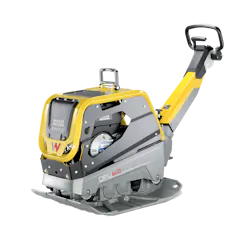
Wacker Neuson is pushing intelligent compaction on the walk-behind side with its DPU52 and 62 diesel plate compactors. The DPU52 and 62 are 11,000- to 14,000-pounds-force,-pounds-force, 1,100-pound-class reversible vibratory plates featuring Compatec, an LED-based intelligent compaction control system that signals when full compaction is achieved. According to product application and training specialist Luke Sevcik, the DPU62 can be equipped with a telematics sensor that relays compaction data back to the office. Compatec is also available for the newly designed RTD-SC4 trench roller, bringing intelligent compaction to the trenches and small open-rolling areas.
“Say you have an inspector on site, and you could prove that you laid down 6 inches of base material,” explains Sevcik. “I ran this machine over it three times. They performed a Troxeler or a nuclear density test and said, 'Yes, you’re at 96 percent compaction.' That tells you and proves it to the inspector that if I laid down 6 inches of material and I hit it three times, with proper moisture densities, this machine will be able to hit that 96 percent or higher every time. So, that way, you can prove to yourself and the inspector and take the testing out of it.”
When using Compatec on the DPU62, the operator reads a simple LED-based display. If the lights keep climbing, compaction is still improving. If the display plateaus, it is time to move on. The telematics layer of Compatec is what makes Wacker Neuson especially interesting here. It brings a piece of larger-equipment IC logic down to a walk-behind plate. On jobs where inspectors, owners, and back-office staff care about documented process, that may become a real differentiator.
“This is not common technology for plate compactors versus a giant ride-on soil roller or an asphalt roller,” says Sevcik. “We’ve actually had this technology in our larger equipment since about 2019. This technology is actually a proving ground. This is going to prove compaction, sending it to the laptop or app. He can see what’s happening in real time via a heat density map. This also proves it to the office where you can save this information.”
Smart compaction gets smaller
Walk-behind intelligent compaction is still in an early phase compared to the full-size roller market. The systems are simpler. Mostly light bars. Manufacturers are taking proven compaction feedback concepts from big soil and asphalt machines and scaling them down to the equipment that handles trench work, utility patches, and other high-risk small-area tasks. This is a practical evolution. They are trying to answer one basic question: Are we done yet?
About the Author
Keith Gribbins
Keith Gribbins is the head of content at Construction Equipment, where he leads editorial strategy across print, digital, video, and social channels. An award-winning journalist with more than 20 years of experience, Keith has won 17 national and regional editorial awards and is known for his hands-on reporting style, regularly visiting manufacturers, operating equipment, and covering major industry events worldwide.