Scissor Lift Market Trends 2026: Data Centers, Lithium Batteries, and Micro Lifts
Key Highlights
- Micro lifts are booming — Data centers and warehouses are driving demand for narrow, highly maneuverable scissor lifts.
- Lithium batteries are rising — Faster charging, zero maintenance, and lower long-term costs are pushing adoption.
- Safety tech is smarter — White-noise alarms, zone lighting, and load sensors are becoming standard features.
While all equipment is shaped by the market served, it would be hard to find a machine more influenced by shifting demand than the scissor lift. Gary Crook, vice president of engineering, MEC Aerial Work Platforms, says data centers are driving the industry right now. “Overhead trunking and cabling are major applications, plus cooling and electrical systems,” he explains.
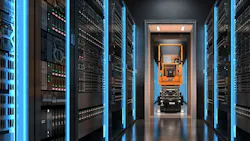
There are a lot of data centers going up, with more in the planning and permitting stages, and they follow a tight pattern. Aisles are narrow — 44 inches is common — to maximize server space and because there are few or no employees roaming the aisles in routine daily operations. Server racks are tall, again to maximize space. The goal is to have the greatest data density, the highest number of terabytes per cubic unit of space. Design uniformity is high.
Scissor lifts should have been ideal for building these cookie-cutter facilities, except they weren’t. Those narrow aisles demand maneuverability that standard scissor lifts could not provide. Enter the micro (or “mini”) scissor lift category. AEM “Slim Scissor Lifts” category WP69 requires a width of less than 34 inches; 32 inches is common in the market. Length is often 20 or more inches shorter than other models of comparable lift height. The narrow width combined with the shorter length provides the necessary maneuverability.
Data centers create the micro lift boom
Why not other solutions? Multimode four-wheel steering, for example. With crab, coordinated and front-wheel steering modes, 4WS would be perfect. Crook says the challenge would be passing the industry’s “pothole test” for stability. That “pothole” is 100 millimeters deep and 600 millimeters square (approximately 4 inches deep and 24 inches square) and 4WS machines likely could not pass in all possible combinations of steering angles. Besides, with wheel cut at or near 90°, 2WS already provides an extremely tight turning radius, often zero inches inside turning radius according to OEM spec sheets. Omnidirectional steering, such as that from Hubtex, could provide maneuverability with stability. MEC had such a unit at one time and Kuka still offers its Triple Lift, which comes only with omnidirectional steering, but the high cost of omnidirectional steering compared to traditional 2WS is a barrier to broad adoption.
Why tight turning beats fancy steering
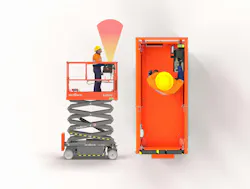
Steel construction and manufacturing, typified by Costco stores and Amazon and Walmart distribution centers, is another robust market. These applications still require narrower, shorter machines but with greater lift height than can be provided by the machines designed for constructing data centers; models developed for this application provide that greater height.
Skyjack has updated its Accessoryzers offerings with many of these features, including a panel carrier with a workload of up to 125 pounds and capable of holding panels up to 4 feet by 12 feet, Skyprotect and Skyprotect+ secondary guarding lift sensing to detect potential collision hazards and XStep32, which brings Skyjack’s XStep technology to all 32 Series electric scissors. (Feature availability varies by model.)
Malcolm Early, vice president of marketing, Skyjack, says that while data centers and warehouses dominate the discussion, traditional applications remain robust. “The rental model for low-level access remains popular for jobsites such as retail, office buildings, schools, hospitals and community centers by offering flexibility, cost control and a broad range of equipment without the overhead of ownership.”
New features improve everyday usability
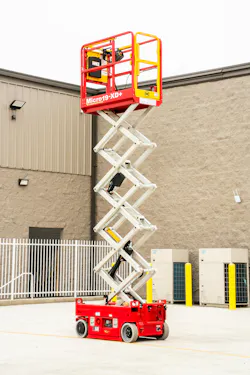
Besides new designs, new features are being developed and existing features are seeing higher demand. Many models have a step the operator can deploy to access narrow overhead spaces without elevating the entire lift and risking entrapment. These steps provide around 20 inches (50 cm) of height. All include a perimeter safety bar that raises and lowers with the platform as it is deployed and stowed. There are also options providing forward extension and some that offer both height and horizontal extension.
Drivability has improved, with many models able to be maneuvered at full lift by the operator. The drive speed is much slower raised than lowered, like 0.5 vs. 3.0 mph, but that’s safe and adequate for positioning the lift at the site.
Accessories and batteries
Assemblies outside the platform hold panels or pipes and tubing. The operator doesn’t have to hold these materials or find space for them on the inside of the operator platform. Some systems allow the panel to be placed precisely so the first fasteners can be put in place without the operator struggling to hold the panel in position while also operating a drill driver. Racking inside the platform area holds tools and equipment.
Corrado Gentile, Genie product director, scissor lifts, says battery technology has advanced. The standard used to be flooded lead acid (FLA), and those are still available. Absorbed glass mat (AGM) served as a bridge technology, offering zero maintenance and longer service life. Front-end cost is higher with AGM but TCO is lower. Gentile says lithium-ion batteries are poised to take over, offering zero maintenance and faster charge rates.
“China virtually requires them,” he notes. “Europe is moving toward broader use of lithium-ion. In North America, acceptance is growing as understanding and awareness expand and many OEMs now offer lithium-ion options.”
Note that, while lithium-ion batteries can be charged on a standard wall outlet, the real advantage comes from using a dedicated lithium-ion charger, which allows a much faster charge.
Safety tech gets louder and brighter
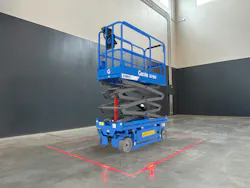
Safety has dramatically improved. OSHA, ANSI and ISO have all been busy crafting new requirements. Some relate to training and documentation. Others are about the hardware. Of the latter, the less obvious results are the addition of sensors that monitor load and position and can limit lift operation if a potentially unsafe condition is detected. The more obvious changes include white noise and perimeter (aka “zone”) lighting.
White noise gives an audible alert when the scissor lift travels, ascends or descends. It is less disruptive and more directional than traditional alarms and is less prone to creating “alarm fatigue” or “vigilance decrement” where workers become habituated to constant alarms and begin to stop noticing them. Its broad audio spectrum is more easily heard by workers wearing hearing protection and those with certain types of hearing loss. Its directional nature makes it easily locatable to help personnel identify the machine(s) from which the white noise is emanating.
Zone lighting provides a visual boundary around the footprint of the machine. Some zone lighting has a fixed range and some is adjustable. The common range is a red or blue halo light extending two feet around the base of the scissor lift. It creates a visual “no-go” zone to protect personnel from movement of the machine and falling objects, such as tools, dropped from the platform. Note: perimeter toe-kicks have become standard to reduce the risk of objects falling off the edge of the platform.
Clean operation becomes a selling point
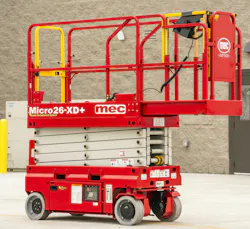
Cleanliness has become increasingly important not just in data centers, but for most customers. Catch trays are common. Since they’re tucked in underneath the lift, any fluid present is very difficult to see and many have sensors to alert operators to the presence of leaked hydraulic fluid captured in the tray. Electric drive motors and steering have reduced the need for hydraulic lines and fittings. Total electric lifts, such as the AE DaVinci Series from JLG, eliminate hydraulics entirely. As of this writing, that series consists of a single model, the AE1932, with a 19-foot maximum platform height and 32-inch width. Other manufacturers also offer all-electric scissor lifts, but electric machines are a small percentage of all models. The challenge with all-electric models is replacing the hydraulic lift mechanism with an electric actuator while retaining long duty cycles at acceptable cost. All-electric models have a price premium of 25 to 40 percent over traditional models of comparable lift.
MEC introduced its PLUS (+) Series of lifts at Conexpo 2026. Among the features is a routing of hydraulic fluid back through the hydraulic motor as the platform is lowered, effectively turning the motor into a generator and recapturing up to 30 percent of the energy expended during the raise cycle. It’s similar in concept to regenerative braking on electric vehicles and can increase duty cycles by up to 22 percent.
North America remains a slab lift market
Gentile says about 95 percent of the scissor lifts sold in North America in 2025 were slab models, while RT (rough terrain) models make up the other 5 percent. It’s estimated that up to 90 to 95 percent of those machines went to the rental market.
RT models are remarkably competent. Outriggers, which can be optional on smaller machines, hold the machine level in two planes when needed during operation. In order to reposition an RT scissor lift when outriggers are in use, the operator must lower the platform, retract the outriggers, reposition the machine, and then redeploy the outriggers and raise the platform. RT scissor lifts offer more capacity and platform space than articulating- or extendable-boom models but less flexibility in positioning once the machine is in place if outriggers are used. Hence, application matters greatly in lift selection. Scissor lifts are better for fenestration or other applications requiring a load be lifted and managed in a specific space. Other lifts are better for tasks such as painting that require access to a large area but with less load.
Four tips for renting the right lift
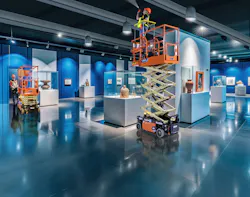
Mirco Negri, senior product manager, specialty equipment, JLG, offers a four-point list for renting the right scissor lift.
- Understand the application. This is true for any equipment rental or purchase, but scissor lifts have their own essential considerations such as space limitations in aisles and doorways, whether materials will be lifted along with personnel and any restrictions on indoor use of the machine, such as exhaust or noise.
- Understand your choices. The first choice is between traditional electric hydraulic lifts and full-electric models. Drivability is another first-line consideration.
- Think about the options. These include measures to accommodate slope, both fore-and-aft and side-to-side. Will you need panel carriers or pipe racks? A welder or air compressor? Is there a battery monitoring system?
- Recognize the differences. Scissor lifts vary in design and feature sets for a reason; each combination exists to optimize performance for specific applications. Talk to the product expert before renting your scissor lift to make sure you get the best machine for you.
About the Author

Richard Ries
Richard Ries began his free lance journalism career in June, 1985, calling on his experience as a service manager at a Honda motorcycle dealership to place his first article. When the motorcycle market collapsed in the late 1980s, he moved to the booming bicycle market. Finding that market lacked the professionalism he sought, he moved to construction in 1995 and has remained there ever since.
His countless clients have included entities in Australia, England, France, Germany and Scotland. He has written for trade and consumer periodicals, equipment and component manufacturers, government agencies and non-governmental organizations. Clients have also commissioned him for photography and videography work, either stand-alone or as part of package of text and images.