Conexpo Insights: Develon and Hyundai Explained
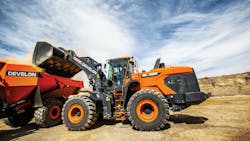
We've covered the name changes and frequent corporate reshufflings among the Doosan, Develon, and Hyundai brands. You might also remember the name HD Hyundai Infracore.
In between the corporate movements, we've seen both Develon and Hyundai add significant new equipment categories to their portfolio in North America, most notably CTLs and dozers. We've also seen interesting progress in autonomous operation (Concept-X).
What's the difference between the two brands? Where's it all going?
This Conexpo, we sought some clarity from Jae-young Moon, president and CEO of HD Construction Equipment, parent company of the brands. Here's our exclusive conversation.

Why did HD Hyundai Construction Equipment and HD Hyundai Infracore merge?
Mr. Moon: As you may know, the two companies were merged on January 1st this year into HD Construction Equipment. This was a strategic decision aimed not only at structurally integrating the two organizations, but also at securing fundamental competitiveness in the global construction equipment market through greater economies of scale.
In particular, by integrating the two companies’ procurement, R&D, and platforms, we have been able to strengthen cost competitiveness, improve the speed at which we can supply products in line with customer needs, and establish a decision-making structure that allows us to respond more quickly to rapidly changing market conditions.
Also, internally we are seeking to maximize efficiency through full integration, while externally maintaining a dual-brand system to expand market coverage. Through this integration, our goal is to make HD Construction Equipment a global top-tier player in the near future.
Why keep two separate brands, Hyundai and Develon, in North America?
Mr. Moon: Keeping two separate brands, which we call a dual-brand strategy, is not limited to North America; it applies across all global markets. Hyundai and Develon each have their own customer bases and market positioning strategy, which allows us to respond more precisely to segmented demand in the U.S. market.
Ultimately, the goal is for HD Construction Equipment to operate as one well integrated company while pursuing a strategy to expand market share through its two strong brands.
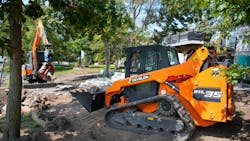
What are the differences in the brands' products other than paint and decals?
Mr. Moon: While specific concepts may vary by product line, the next-generation models launched in 2025 were designed around the direction each brand is heading towards and its philosophy.
For Hyundai, to deliver on its brand identity of “Comfort Intelligence,” the operating modes were developed to be user-friendly, intuitive, and simple. On the control side, the brand focused on improving work efficiency by providing a more comfortable, more responsive operating feel.
For Develon, in line with the brand slogan, “Powered by Innovation,” the brand offers a wider range of work modes to expand user choice, and configured the machines to enable smooth and precise operation across diverse job site conditions.
What makes the Hyundai and Develon brands different than the North American market leader?
Mr. Moon: Develon and Hyundai offer differentiated value propositions built around responsiveness and customer-focused innovation. Develon delivers premium features as standard equipment, enhancing job site safety, operator visibility, and productivity without driving up acquisition cost.
Hyundai, on the other hand, emphasizes job site efficiency and cost control, providing strong performance, fuel economy, and practical technology that supports contractors’ bottom-line results.
In addition, both brands are represented primarily by family-owned dealer businesses across North America, enabling faster decision-making, closer customer relationships, and greater flexibility in responding to local market needs.
For many contractors, that combination of performance, value, and dealer agility presents a compelling alternative in today’s competitive equipment landscape.
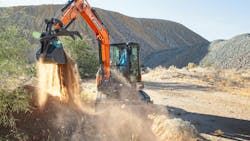
The enthusiasm for electric equipment (EVs) in North America seems to have waned at present, have the Hyundai and Develon brands made any adjustments to their EV plans?
Mr. Moon: It’s true that interest in and adoption of electric equipment have recently slowed somewhat in North America compared with earlier expectations. This reflects a combination of factors, including the maturity of charging infrastructure, customers’ concerns over total cost of ownership (TCO), and broader market conditions.
Even so, when we consider tightening environmental regulations, decarbonization requirements, and the need for better working environments, we believe electrification will become a necessity rather than an option.
Accordingly, both Hyundai and Develon are taking a long-term view and continuing to execute the strategies already in place without changing direction. That said, we are adopting a more practical approach based on the market’s and customers’ level of readiness.
Learn what Local 150 pros thought about a Develon dozer
We are expanding electric equipment in phases, focusing first on applications where it can deliver clear value—such as urban job sites, indoor operations, and use cases where low noise and zero emissions are especially important. While the market may be in a period of adjustment for now, the strategic commitment and direction of both Hyundai and Develon remain unchanged. We will continue to stay the course so that we are well positioned to compete when the market returns to a growth phase.
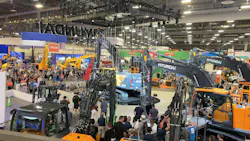
Where do the Hyundai and Develon brands stand on hydrogen-powered equipment?
Mr. Moon: HD Construction Equipment is currently developing equipment powered by both hydrogen combustion engines and hydrogen fuel cells. For hydrogen combustion engines, we are currently developing the HX12 and HX22 models for trucks, buses, and power generation applications.
We have also developed a demo machine by installing the HX12 engine in a 34-ton excavator and completed performance verification. In excavator working-mode, we have confirmed commercial-level performance comparable to that of a conventional diesel engine.
Commercial production of equipment with hydrogen combustion engines is still under review. We plan to respond flexibly and proactively in line with the pace of hydrogen economy development, including refueling and infrastructure expansion. We have been working on hydrogen fuel cell-powered construction equipment since 2020 and are currently preparing demonstration testing at actual job sites.
A prototype on Hyundai’s 14-ton wheeled excavator has been showcased several times, including at Conexpo 2023, and we have continued to advance the technology since then. In addition, we are also developing hydrogen storage technology and mobile hydrogen refueling stations suited to construction sites and operating environments. Commercialization will be reviewed based on market demand.
What is the latest update on Concept-X?
Mr. Moon: There are two updates to share on Concept-X. First, we have further advanced the autonomous excavation technology originally introduced through Concept-X and evolved it into a new form called Real-X. Real-X is an AI-based technology designed to perform key tasks required at actual earthwork sites—such as trenching, pipeline excavation, and truck loading—without an operator.
The Concept-X origin story
The technology was unveiled last year at Bauma. Real-X has now reached the technology demonstration stage, and we are continuing to enhance it in collaboration with the autonomous tech company, Gravis. Specifically, we are conducting field demonstrations at operating sites in Europe such as quarries, while also pursuing commercialization.
Second, some of the core technologies developed through the Concept-X program have been applied to HD Construction Equipment’s next-generation excavator models. Examples include Advanced Lift Assist, which detects and warns of potential rollover risks in advance during heavy lifting operations, and an E-Stop function that combines camera and radar data to recognize objects around the machine and prevent collision risks with workers during travel and swing operations.
Checking out Concept-X in Korea
The excavator E-Stop reflects an updated technology direction for camera-radar sensor fusion-based object detection (OD), which was presented at CES 2024 and received a CES Innovation Award. We plan to apply this technology to next-generation models within this year to further improve safety at construction sites.
About the Author
 Frank Raczon
Frank Raczon
Frank Raczon has influenced and covered the equipment industry for 35 years, including 15 years as senior editor of Construction Equipment, and marketing, advertising, and public relations work for the industry's top manufacturers. He authored "Caterpillar: Modern Earthmoving Marvels" (Motorbooks, 2015), and has won numerous awards in his career, highlighted by nods from the Construction Writers Association, the Association of Equipment Manufacturers, the Business Marketing Association, and BtoB magazine. Raczon has also won awards from publishing peer groups such as ASBPE and TABPI.