Tool Carriers and Couplers Promote Utility
- "Official" tool-carrier talents
- Tool-carrier linkage
- Coupler choices
- Tool-Carrier Models
- Case
- Gehl
- Mustang
- Caterpillar
- JCB
- Kawasaki
- VersaDyne
- John Deere
- Liebherr
- Komatsu
- New Holland
- Daewoo
- Volvo
- Terex
- Hyundai
True, the skid-steer, backhoe-loader and hydraulic excavator are becoming ever more versatile with their ability to handle an expanding array of work tools and, thus, legitimately could be called "tool carriers." That term, however, usually is reserved for a special version of the wheel loader, which, according to some, originated the tool-carrier concept more than 50 years ago.
Most every conventional wheel loader, of course, can be made more versatile by removing its pin-on bucket and substituting a coupler. The coupler's obvious advantage is that it allows the machine to quickly switch work tools — more often than not, between a bucket and a set of forks.
A coupler, however, may not be a good investment for every wheel-loader user. According to Elmer Secker, principal and founder of SAS Quick Coupler Systems, you're probably wasting your money on a coupler if you have opportunity to change work tools only once per month. But if changing tools at least once per week would be beneficial, then the economics, in terms of time saved and production gained, are in your favor. The "gray area" in between requires a judgment call, says Secker, but should be made with an eye toward the possibility of having to occasionally switch tools to handle emergencies.
"Official" tool-carrier talents
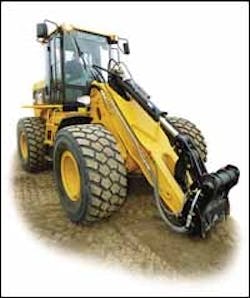
So, does this mean that if you install a coupler on your wheel loader, then you have a tool carrier? It's a fine line of distinction, but most wheel-loader manufacturers have two basic criteria for classifying a wheel loader as a tool carrier. To wit, the machine must have a coupler and it must have front linkage that provides parallel lift, that is, the capability to automatically keep a load level throughout the lifting arc — from bottom to top — without operator intervention.
New Holland's Eric Winkler also notes a lesser-realized advantage of parallel linkage — the ability to maintain its breakout force nearly intact from ground level to full height. Conventional Z-bar linkage, typically used on wheel loaders that spend their days hogging dirt or loading gravel, normally loses significant force as the bucket rises through its lift arc. This isn't to say, though, that the tool-carrier's linkage is superior to that of a conventional wheel loader. The designs differ for a purpose.
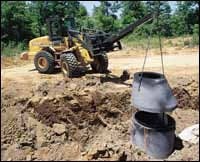
The tool-carrier's linkage is designed to accommodate heavy loads that often must be lifted and placed with precision at relatively high levels. The conventional wheel-loader's linkage, by comparison, usually allows the machine to be a more aggressive excavator, since typically it generates greater bucket-breakout forces at low boom levels than does a tool carrier. But, that said, some wheel-loader manufacturers would take issue, saying that their proprietary linkage systems provide both parallel-lift and Z-bar-linkage power.
The term you may often hear applied to the design of tool-carrier (parallel-lift) linkage is "eight-bar", which refers to the number of moving elements in the design. Wheel-loader manufacturers who use this basic linkage usually tweak its design to work effectively with their products. But, says Terex's Lowell Stout, parallel lift can be achieved with fewer elements than eight. The Terex tool-carrier linkage is a simpler four-bar system, he says, and uses only one bucket cylinder, compared to the eight-bar's two cylinders.
John Deere's new Powerllel linkage is representative of patented or proprietary linkage systems used on certain tool-carrier makes. Each of Deere's new mid-range J-Series wheel loaders — the 444J, 544J and 624J — is available with either a Z-Bar or the optional Powerllel linkage. The new linkage, says the company, provides parallel lift, can be used with pin-on attachments or a coupler, uses geometry that enhances boom power at all positions and provides effective breakout forces.
Volvo has a unique approach to wheel-loader design, equipping all of its full-size North American models with the patented Torque-Parallel (TP) linkage, which, says Volvo, combines parallel lift and high breakout torque to yield power throughout the machine's lifting range. The TP design also is used on two of the company's compact wheel loaders, the L40B and L45B.
According to Volvo's Dan Snedecor, the company considers every TP wheel loader a potential tool carrier, because each is available with a Volvo-built attachment bracket and a selection of attachments. In fact, says Snedecor, Volvo claims to be the pioneer of the tool-carrier concept, having introduced its first "quick coupler" in 1954.
Caterpillar, on the other hand, uses two types of parallel-lift linkage — the more conventional multi-bar type on its three Integrated Tool Carrier (IT) models, and the VersaLink system on the 924G and 930G, as well as on the 906 and 908 compact loaders. The two systems, says the company, are designed to match specific application requirements encountered by machines in different size classes.
Caterpillar's VersaLink system incorporates a single, fabricated boom arm, centered on the front frame, in conjunction with proprietary linkage. This design, says Cat, combines the parallel-lift and attachment-handling traits of the tool carrier with the digging strength and speed of a conventional loader. Caterpillar, like Volvo, also makes its own couplers.
Both Gehl and Mustang use a "short-link Z-bar linkage" — designed to provide parallel lift — on two models in their respective all-wheel-steer-loader lines. Both companies also use more conventional parallel-lift linkage on two additional models in their respective lines.
The definition of the wheel-loader-based tool carrier, say some manufacturers, should be expanded to include compact wheel loaders that are equipped with a "universal" (skid-steer-loader-type) coupler and also have parallel-lift linkage.
Volvo's two smallest loaders, for example, the L20B and L25B, which use a non-TP parallel-lift linkage, can be fitted with either the Volvo attachment bracket or a universal coupler. The VersaDyne Model 3K is another small loader that combines parallel linkage with a universal coupler, and the all-wheel-steer loaders from Gehl and Mustang can be fitted with an optional universal attachment plate (Skid-a-Tach) that mounts to their standard, wheel-loader-style coupler.
Unlike the universal coupler, which reflects a common design from manufacturer to manufacturer, couplers for wheel loaders and tool carriers vary in design. The basic concept for various couplers is similar, since most (but not all) use two stationary pins or shafts near the top of the frame and a pair of horizontal locking pins at the bottom. Designs vary, however, in regard to the size and location of the upper and lower pins.
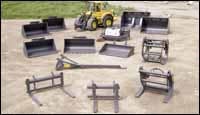
This means, then, that work tools must be configured to mate with specific couplers. Most work tools are attached to the coupler via two "ribs" on their backside. The ribs have hook-like lugs that latch over the coupler's upper pins, and near the bottom are holes that accept the hydraulically (usually) actuated locking pins at the coupler base.
Although ribs of a different configuration can be substituted for those on an existing work tool in order to accommodate a different coupler, David Crummy, director of sales and marketing for JRB Attachments, advises caution. The ribs may be an integral part of the work tool's structure, he says, and modification could jeopardize the tool's integrity.
Couplers for wheel loaders usually are available through the machine distributor, who may carry either the wheel-loader manufacturer's proprietary version, or those from independent manufacturers — JRB Attachments, ACS Industries, SAS Quick Coupler Systems, IMAC and Pemberton — to name a few.
Couplers on tool carriers generally are installed at the factory and may be either the machine manufacturer's own design or that of a preferred vendor. In the latter instance, you may sometimes have a choice. For example, Case's David Wolf notes that the company's three tool-carrier models are available with either a JRB or ACS system. (The ACS system uses a "V" type locking system at the top of the coupler, and on some models, vertical locking pins.)
For what it's worth, 20 to 30 percent of wheel-loader buyers, depending on the manufacturer you ask, opt for tool-carrier versions.
| Web Resources | ||
| Case www.casece.com | ||
| Caterpillar www.caterpillar.com | Daewoo www.dhiac.com | |
| John Deere www.deere.com | Gehl wwwwww.gehl.com | |
| Hyundai www.hceusa.com | JCB www.jcb.com | |
| Kawasaki www.kawasakiloaders.com | Komatsu www.komatsuamerica.com | |
| Liebherr www.liebherr.com | Mustang www.mustangmfg.com | |
| New Holland www.newhollandconstruction.com | Terex www.terex.com | |
| VersaDyne www.linco.com | Volvo www.volvoce.com | |