Concentrated Power and Versatility: Small Wheel Loaders
| In this story: |
|---|
| Tables: | ||
|---|---|---|
|
|
||
|
Perhaps you've noticed in the last five years or so that an increasing number of prominent brand names have been showing up on small wheel loaders. Some might say that these "compact" loaders are relatively new to the North American market, the result of marketers noting the success of these machines on congested European jobsites and bringing the concept here.
But, just to set the record straight, small wheel loaders aren't a new phenomenon on this side of the Atlantic. The once-mighty International Harvester, for example, was building small wheel loaders for worldwide consumption in the mid-1960s, and brand names such as Waldon, Swinger, Power Trac and TCM have endured successfully in the U.S. market.
That said, however, there's no denying that the North American market has rediscovered the compact wheel loader in recent years, as evidenced by the expanding number of suppliers and the corresponding rise in sales numbers. And with this rediscovery has come a new generation of machines, which skillfully concentrate the power and versatility of larger loaders into much smaller packages.
Our introduction to the design specifics of today's small wheel loaders came a year or so ago when Volvo loaned Construction Equipment an L20B for an installment of Hands-On Earthmoving. The 56-horsepower L20B features dual-range hydrostatic drive, parallel-lift loader linkage, standard auxiliary hydraulics, choice of proprietary or universal coupler (both hydraulic) and operator amenities that include a multi-function joystick with built-in switches for transmission control and for ground-speed control independent of throttle position.
According to David Morice — heavy-line sales manager for JCB, whose 67-net-horsepower models 407ZX and 409ZX just missed our cutoff — the small wheel loader's market success is establishing a trend toward even more design enhancement, including such features as high-flow auxiliary hydraulics, more precise return-to-dig systems and ride-control.
At the heart of their design, compacts neatly insert conventional wheel-loader features — efficient truck loading, load-and-carry capability, smooth ride, stability, friendly steering, roomy cab and attachment-handling ability — into packages of more application-accommodating size. Wheel-loader buyers simply have more choice now for matching machine size to the needs of a given operation.
The size of compact wheel loaders within the horsepower class (65 net and less) that this report addresses varies considerably. Operating weights range from less than 1,500 pounds to more than 12,000 pounds, net horsepower ratings from the low twenties to 65, and hinge-pin heights from around 105 to nearly 130 inches. Despite the wide variations, these machines do, however, exhibit general similarities.
Most, for example, are hydrostatically driven, usually with the combination of a single high-pressure, variable-displacement hydraulic pump and single hydraulic motor. The motor in most units drives through a mechanical gearbox to conventional planetary axles, which often use sealed, wet-disc brakes. Maximum travel speeds may range from the low teens to 25 mph.
Most also employ articulated-frame steering, but with notable exceptions. Gehl and Mustang units (except for the articulated Gehl AL20DX) feature all-wheel steering in conjunction with their one-piece frame. The Deere 244J is a hybrid of sorts, incorporating both articulated-frame steering and rear-wheel steering — a system Deere calls Stereo Steering.
Implement-hydraulic systems are typically gear-pump systems, and an auxiliary hydraulic system (providing flow to powered attachments) often is available. These auxiliary systems, however, usually don't produce oil flows that compare with the output of high-flow systems in large skid-steers. Although this limitation might preclude the use of certain attachments, many hydraulically powered tools can still be used. According to Caterpillar, for instance, its model 904B, with a 22-gpm auxiliary system, can handle trenchers, snow blowers, stump grinders and cold planers.
The question buyers should ask in this regard, though, is whether the auxiliary flow in the specific wheel loader model being considered is sufficient to power attachments intended for use with it.
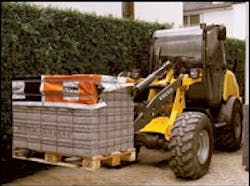
It's probably safe to say that when the new generation of compacts began appearing, available attachments, in many instances, were limited to pallet forks and specialty buckets — such as multi-purpose, side-dump and stone-sieve types.
Even though many of these machines were equipped (or could be equipped) with a universal (skid-steer) type coupler, manufacturers generally were cautious about recommending the use of skid-steer attachments with compact wheel loaders. Since many compacts use Z-bar loader linkage (or a variation thereof), which typically generates considerably higher breakout force than does skid-steer-loader linkage, the concern was that these stronger machines would structurally overpower attachments designed for skid-steers loaders.
"Placing a skid-steer bucket on a compact wheel loader is not a good idea," says Georg Seyrlehner, Ingersoll Rand's product manager for earthmoving equipment. "Given the wheel loader's greater breakout force, there's potential for damaging both the bucket and the coupler."
As the market has matured, however, more attachments have been developed specifically for the compact wheel loader, further expanding its versatility.
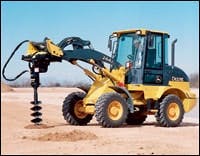
"Specialty buckets and forks still remain the most popular attachments," says product manager David Wolf at Case, "but brooms, augers and ground-conditioning attachments, for example, are now generally available."
The best advice about using skid-steer tools on a small wheel loader is to ask your dealer if a specific attachment's structural strength and (if powered) its hydraulic flow and pressure requirements are a match for the wheel loader in question.
In addition, buyers should be aware of two other considerations related to attachment use with small wheel loaders: coupler type and loader-linkage type. Regarding couplers, some manufacturers equip their compacts with only conventional wheel-loader-type couplers, others use the universal-style coupler, and still others use the conventional coupler, but offer a universal-style adapter.
Loader linkage is typically either standard Z-bar or parallel-lift. The latter automatically keeps pallet forks level from ground level to full lift, which is handy if the machine frequently works with forks. Depending on the specific linkage, however, the parallel-lift configuration may sacrifice a bit of digging force. But not always; some manufacturers claim linkages that competently blend the best qualities of both linkage types.
A final consideration you might have, of course, is whether a compact wheel loader or comparably sized skid-steer loader is the right choice for your operation.
"That's not an easy decision in some instances," says Gehl's Brian Rabe, "because both machines have distinct advantages. I try to help customers think through all aspects of their operation before making that choice."
| Web Resources | ||
| Specifications | Atlas www.atlasloaders.com | |
| Buhler www.buhler.com | Case www.casece.com | |
| Caterpillar www.caterpillar.com | Coyote www.coyoteloaders.com | |
| Deere www.deere.com | Dressta www.dresstanorthamerica.com | |
| Gehl www.gehl.com | Ingersoll Rand www.irco.com | |
| JCB www.jcb.com | Komatsu www.komatsuamerica.com | |
| Kawasaki www.kawasakiloaders.com | Kubota www.kubota.com | |
| Link-Belt www.lbxco.com | Mustang www.mustangmfg.com | |
| New Holland www.newhollandconstruction.com | Power-Trac www.power-trac.com | |
| Swinger www.nmc-wollard.com | TCM www.mmdequipment.com | |
| Terex www.terex.com | Volvo www.volvoce.com | |
| Waldon www.waldonequipment.com | Yanmar www.yanmar.com | |
| * This list includes suppliers encompassed in the broader definition of "compact" wheel loaders, those with up to 110 gross horsepower. | ||